Stop Wrestling with AI Agent Chaos—klaw Is the kubectl Fix You Need
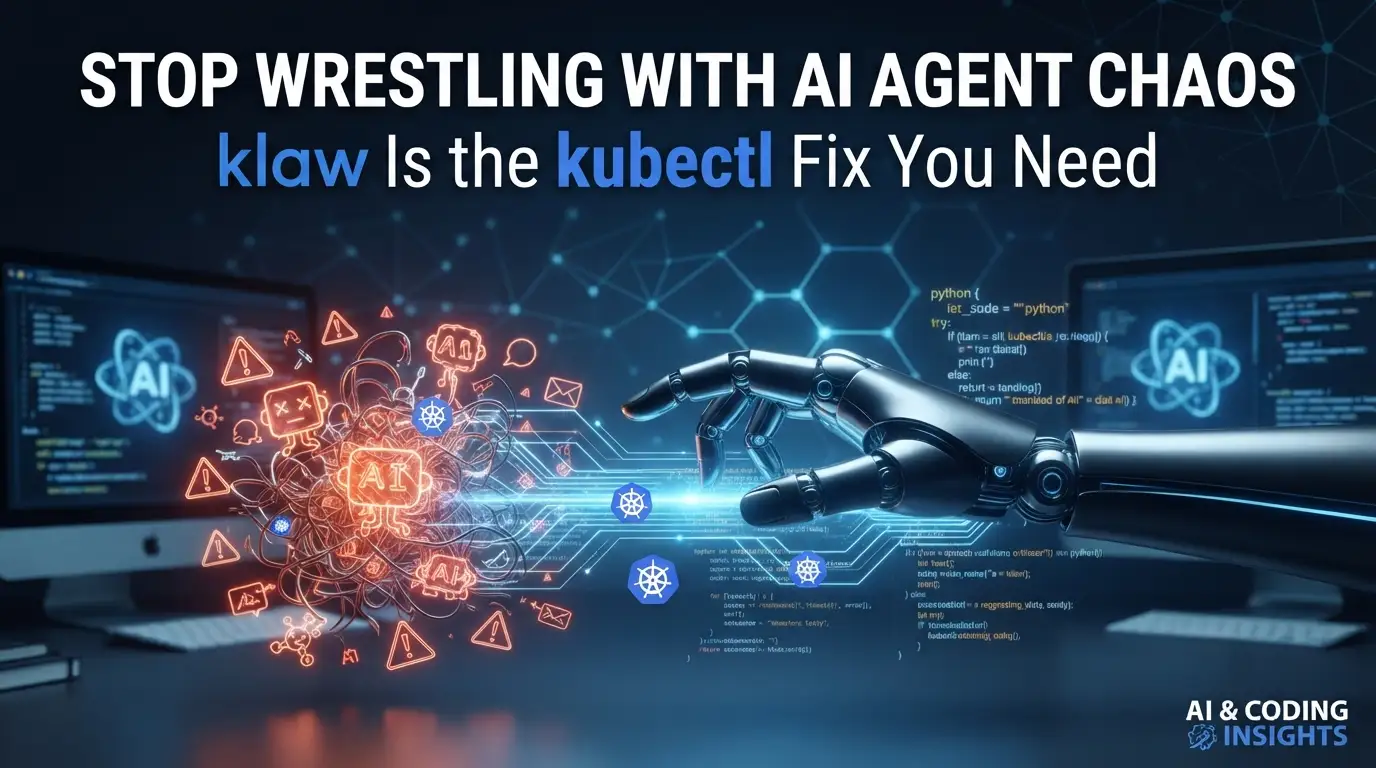
Your lead scorer went silent three hours ago. The competitor monitor just blasted pricing alerts into the wrong Slack channel. Your support ticket handler is hallucinating responses to enterprise customers. And somewhere in the abyss of CloudWatch logs, the answer to "what went wrong?" is hiding—if only you could find it.
Sound familiar? You're not alone. The AI agent revolution arrived with a bang, but the infrastructure to manage these digital workers? That's still stuck in the stone age. Most teams are duct-taping together cron jobs, Lambda functions, and prayer. There's no visibility, no isolation, no sane way to debug. It's Kubernetes circa 2013 all over again—except worse, because these "pods" are making autonomous decisions that affect your revenue.
What if managing AI agents felt as natural as managing containers? What if one binary, one command, could transform that chaos into order? Enter klaw—the open-source tool that's being called "kubectl for AI agents." Built by the engineers at each::labs, klaw brings the battle-tested patterns of Kubernetes orchestration to your AI workforce. One binary. Deploys in seconds. Scales to hundreds of agents. And yes, you can control everything from Slack while sipping your coffee.
Ready to stop treating your AI agents like untamed beasts and start treating them like the infrastructure they are? Let's dive deep into why klaw is about to become the most important tool in your AI stack.
What Is klaw? The Infrastructure Layer AI Agents Desperately Need
klaw is enterprise AI agent orchestration that treats your autonomous workers as first-class infrastructure citizens. Created by each::labs, a team obsessed with making AI operations actually operational, klaw solves the fundamental gap in today's AI ecosystem: we've figured out how to build agents, but we're catastrophically bad at running them.
The genius of klaw lies in its conceptual theft—blatantly and brilliantly stealing from Kubernetes. If kubectl lets you inspect, manage, and scale containerized applications, klaw does the same for AI agents. The mental model is identical because it works. Developers already understand pods, namespaces, and logs. Why force them to learn an entirely new paradigm for AI operations?
Here's why klaw is trending right now: the AI agent landscape has exploded, but deployment patterns remain embarrassingly primitive. Frameworks like LangChain and CrewAI help you construct agents, but they drop you at the finish line of a marathon. Actually running those agents in production—scheduling them, monitoring them, securing them, scaling them—remains an unsolved nightmare. klaw steps into that void with a single Go binary that deploys anywhere: your laptop, a VPC, even air-gapped environments.
The project has gained serious traction because it speaks a language developers already fluently understand. No new abstractions to memorize. No YAML hell (unless you want it). Just klaw get agents, klaw logs, klaw describe agent—commands that feel like muscle memory because they are.
Key Features: The Technical Depth That Separates Toys from Tools
klaw isn't a wrapper around someone else's API. It's a full control plane with architectural decisions that reveal serious engineering intent.
Kubernetes-Parallel CLI Design
The command structure deliberately mirrors kubectl because cognitive load kills adoption. Every operation maps cleanly: klaw get agents ↔ kubectl get pods, klaw describe agent ↔ kubectl describe pod, klaw logs ↔ kubectl logs. This isn't laziness—it's interface ergonomics at scale. Teams adopt klaw in hours, not weeks.
Namespace-Based Isolation
Real enterprises don't run everything in default. klaw implements namespaces with scoped secrets and tool permissions. Your sales agent accessing HubSpot can't accidentally reach your support team's Zendesk credentials. This is logical isolation with secret scoping and tool allowlisting—not full container sandboxing, but production-grade boundaries that prevent the "oops, wrong API key" disasters.
Built-In Cron Scheduler
Forget wrestling with system cron, Lambda triggers, or external schedulers. klaw's native cron system lets you define agent execution patterns with familiar syntax: klaw cron create score-leads --schedule "0 * * * *". Timezone-aware, namespace-scoped, and observable through the same CLI you use for everything else.
Dual Control Planes: CLI and Slack Some operations demand terminal precision; others need collaborative accessibility. klaw doesn't force a choice. The Slack integration turns any channel into an AI command center—status checks, manual triggers, log tailing, even natural language queries. The same operations work identically in both interfaces because they hit the same API.
Distributed Mode for Serious Scale
Single-node for development, distributed for production. The controller-worker architecture lets you add capacity with klaw node join—automatic task dispatch across available workers. No manual load balancing. No complex service mesh. Just nodes that register, receive work, and report back.
300+ Model Router via each::labs Vendor lock-in is a trap. klaw connects to Anthropic, OpenAI, Google, Azure, Ollama, and any OpenAI-compatible endpoint through a unified configuration. Swap models per-agent, per-task, or per-environment without code changes.
Use Cases: Where klaw Transforms Chaos into Competence
Sales Operations: The Always-On Lead Scorer
Modern sales teams can't afford delayed lead response. But building a reliable lead-scoring agent traditionally means: a Python↗ Bright Coding Blog script, a cron job that silently fails, API credential sprawl, and zero visibility when it breaks. With klaw, you define the agent, schedule it, and monitor it—all through one interface. When the HubSpot integration hiccups, you see it in klaw logs immediately, not three deals later.
Competitive Intelligence: The Sleeper Agent
Your competitor just changed pricing. Again. Manual monitoring is soul-crushing; automated monitoring without orchestration is fragile. klaw's competitor-watch pattern runs daily, posts diffs to the right Slack channel, and lives in an isolated namespace with only web-search and Slack tools. When the website structure changes and the agent breaks, you know exactly where to look.
Customer Support: The Triage That Never Sleeps
Support ticket volume spikes at 2 AM. Your human team doesn't. klaw's ticket-handler can auto-respond to routine queries, draft responses for complex ones, and escalate with full context. The Slack integration means support managers can @klaw check ticket #12345 without learning a new tool or context-switching to yet another dashboard.
Analytics: The Report That Actually Ships
Weekly reports die because someone forgets to run the script, or the script breaks, or the output goes to the wrong place. klaw's cron-scheduled report-gen queries databases, generates visualizations, and posts to #team-updates every Monday at 8 AM. When the SQL schema changes and the query fails, the logs are centralized and searchable—not buried in a container you already deleted.
Step-by-Step Installation & Setup Guide
Getting klaw operational is deliberately minimal. The each::labs team optimized for "works in five minutes" without sacrificing production rigor.
Installation
# The one-liner that starts everything
curl -fsSL https://klaw.sh/install.sh | sh
For source builds or specific versions:
git clone https://github.com/klawsh/klaw.sh.git
cd klaw && make build
sudo mv bin/klaw /usr/local/bin/
Verify your installation:
klaw version
# Expected output: klaw v1.0.0 (darwin/arm64) or similar
Provider Configuration
klaw requires at least one LLM provider. Set your preferred API key as an environment variable:
# Option 1: Direct Anthropic access
export ANTHROPIC_API_KEY=sk-ant-api03-your-key-here

# Option 2: OpenRouter for 100+ models
export OPENROUTER_API_KEY=sk-or-v1-your-key-here

# Option 3: each::labs router for 300+ models
export EACHLABS_API_KEY=your-eachlabs-key
For persistent configuration, create ~/.klaw/config.toml:
[defaults]
model = "claude-sonnet-4-20250514"
namespace = "default"

[provider.anthropic]
api_key = "${ANTHROPIC_API_KEY}"
Running Your First Agent
Interactive mode for exploration:
klaw chat
Full platform with Slack integration:
export SLACK_BOT_TOKEN=xoxb-your-bot-token
export SLACK_APP_TOKEN=xapp-your-app-token
klaw start
Distributed Deployment (Production)
# On your controller node
klaw controller start --port 9090

# On each worker node
klaw node join controller.internal:9090 --token $TOKEN
REAL Code Examples: Learn from the Repository Itself
The klaw README contains production-ready patterns. Here are the most instructive, explained in depth.
Example 1: Creating and Scheduling a Sales Agent
# Create the agent with explicit namespace, model, and capability declaration
klaw create agent lead-scorer \
  --namespace sales \
  --model claude-sonnet-4-20250514 \
  --skills crm,web-search

# Schedule recurring execution with cron syntax
klaw cron create score-leads \
  --schedule "0 * * * *" \
  --agent lead-scorer \
  --task "Analyze new leads in HubSpot, score 1-100 based on fit, update Lead Score field"

# Verify operational status
klaw get agents -n sales
klaw logs lead-scorer
What's happening here? This pattern demonstrates klaw's declarative philosophy. Unlike imperative scripts that embed scheduling logic, the agent definition is pure configuration. The --skills flag acts as a capability contract—klaw knows this agent may request CRM and web-search tools. The cron job separates when from what, enabling independent modification. The -n sales namespace flag ensures multi-tenant safety if your team runs multiple domains.
Example 2: Real-Time Log Inspection
# Follow logs for live debugging (the -f flag mirrors kubectl behavior)
klaw logs lead-scorer --follow

# Sample output:
# [14:32:01] Fetching new leads from HubSpot...
# [14:32:03] Found 12 new leads
# [14:32:05] Analyzing lead: john@acme.com
# [14:32:08] Score: 85/100 (Enterprise, good fit)
# [14:32:09] Updated HubSpot lead score
Why this matters: Traditional agent debugging requires correlating timestamps across multiple services—your scheduler, your LLM provider, your CRM API logs. klaw centralizes agent-annotated logs with structured timestamps and semantic context. The --follow flag enables real-time debugging during incidents, just like tailing application logs in Kubernetes.
Example 3: Slack-Native Operations
# In any Slack channel where klaw is invited:

You: @klaw status

klaw: 📊 Agent Status
      ├── lead-scorer (sales) — running, 2m ago
      ├── competitor-watch (research) — idle
      ├── ticket-handler (support) — running, 30s ago
      └── report-gen (analytics) — idle

You: @klaw run competitor-watch

klaw: 🚀 Starting competitor-watch...
      Checking competitor.com/pricing...
      Found 2 pricing changes since yesterday.
      Posted summary to #competitive-intel
The architectural insight: Slack isn't a bolt-on; it's a first-class control plane. The same API that serves CLI commands serves Slack interactions. This means audit trails, access controls, and operational patterns are consistent regardless of interface. For teams where not everyone lives in terminals, this democratizes AI operations without creating shadow infrastructure.
Example 4: Custom Provider Configuration (Ollama Local)
# ~/.klaw/config.toml — local development with open models
[provider.ollama]
base_url = "http://localhost:11434/v1"
model = "llama3.2"
# Use the local provider explicitly
klaw chat -p ollama
The flexibility revealed: klaw's provider system uses OpenAI-compatible API conventions, making it universally adaptable. Ollama for local privacy-sensitive work. LM Studio for experimentation. Together AI for cost-effective inference. The -p flag enables per-command provider selection, critical for A/B testing models or handling data residency requirements.
Advanced Usage & Best Practices
Namespace Strategy for Enterprise Scale
Don't under-namespace. Create domains around blast radius: sales, support, research, finance. Within each, use secrets and allowed_tools to enforce least-privilege. A compromised sales agent should never reach finance systems—not through policy, but through technical enforcement.
Model Fallback Patterns
Configure multiple providers in config.toml. When Anthropic rate-limits, klaw can route to OpenRouter or each::labs without agent modification. For critical agents, define model tiers: premium for customer-facing, economical for internal analytics.
Log Retention and Observability
klaw logs solves immediate debugging, but integrate with your existing observability stack for historical analysis. The structured output format (timestamp, agent, operation, result) parses cleanly into Loki, Datadog, or Splunk.
Distributed Mode Topology
Run controllers with redundancy behind a load balancer. Workers auto-register and heartbeat; failed nodes get their tasks redispatched. Use klaw drain node before maintenance to gracefully migrate workloads—exactly like Kubernetes pod eviction.
Security: Understand the Isolation Boundary
klaw's namespaces provide logical isolation, not process isolation. Agents run under your user account and can access any file you can. For untrusted or externally-facing agents, wrap execution in Podman containers using klaw run with container runtime flags.
Comparison with Alternatives: Why klaw Wins
| Feature | klaw | OpenClaw | LangChain | CrewAI | AutoGPT |
|---|---|---|---|---|---|
| Single Binary | ✅ | ❌ | ❌ | ❌ | ❌ |
| kubectl-style CLI | ✅ | ❌ | ❌ | ❌ | ❌ |
| Slack Control | ✅ | ✅ | Manual | Manual | ❌ |
| Namespaces | ✅ | ❌ | ❌ | ❌ | ❌ |
| Built-in Cron | ✅ | ❌ | ❌ | ❌ | ❌ |
| Distributed Mode | ✅ | ❌ | ❌ | ❌ | ❌ |
| 300+ Models | ✅ | ✅ | ✅ | ✅ | ❌ |
| Easy Deployment | ✅ | ❌ | ❌ | ❌ | ❌ |
| Enterprise Ready | ✅ | Partial | Partial | Partial | ❌ |
OpenClaw pioneered AI agent frameworks but suffers deployment complexity—Node.js, multiple services, painful scaling. LangChain and CrewAI are construction kits, not infrastructure. You build agents with them; you don't operate them at scale. AutoGPT demonstrated autonomous agent potential but never solved production reliability. klaw uniquely occupies the operations layer: it assumes agents exist and makes them runnable, observable, and scalable.
FAQ: Your Burning Questions Answered
"How is klaw different from OpenClaw?" OpenClaw is powerful but complex—multi-service Node.js architecture, difficult deployment, harder scaling. klaw delivers equivalent agent capabilities through a single Go binary with kubectl-style ergonomics. Deploy in seconds, scale by adding nodes.
"Can I use klaw with agents I built in LangChain?" Absolutely. LangChain and CrewAI are frameworks for building agents. klaw is infrastructure for operating them. Build with whatever framework you prefer; deploy and manage with klaw.
"Is klaw actually secure? What about sandboxing?"
Namespaces provide logical isolation—scoped secrets and tool permissions prevent accidental cross-contamination. However, agents run under your user account without filesystem sandboxing. For true process isolation, execute agents in Podman containers via klaw run.
"Does klaw work on-premise or air-gapped?" Yes. Single binary, zero external dependencies. Configure local providers like Ollama for fully disconnected operation. You control all data and execution.
"What models can I use?" 300+ via each::labs router, or direct connections to Anthropic, OpenAI, Google, Azure, and any OpenAI-compatible endpoint including Ollama, LM Studio, vLLM, Together AI, and more.
"Is klaw free for commercial use?" Free for internal business use, personal projects, and consulting. A license is required only for multi-tenant SaaS or white-label distribution. See the each::labs License for specifics.
"How do I get help or contribute?" Documentation lives at klaw.sh/docs. Issues and PRs welcome on GitHub. Real-time community support on Discord.
Conclusion: The Infrastructure Gap Is Closed—Start Orchestrating
The AI agent revolution stalled not because we couldn't build smart systems, but because we couldn't run them smartly. Every failed cron job, every mystery outage, every credential leak traced back to the same root cause: treating autonomous software like scripts instead of infrastructure.
klaw fixes this with radical simplicity. One binary. Familiar commands. Real isolation. Observable execution. Slack-native control. The Kubernetes playbook applied to AI agents because that playbook has been production-hardened for a decade.
I've evaluated every tool in this space. Nothing else combines deployment simplicity with operational depth. Nothing else respects your existing mental models while solving genuinely new problems. klaw isn't just another agent framework—it's the missing infrastructure layer that makes all those frameworks production-viable.
Your agents are only as reliable as their orchestration. Stop duct-taping. Start commanding.
👉 Install klaw now: curl -fsSL https://klaw.sh/install.sh | sh
⭐ Star the project on GitHub: github.com/klawsh/klaw.sh
📖 Read the full docs: klaw.sh/docs
Your future self—debugging an agent at 3 AM with klaw logs --follow instead of grepping through CloudWatch—will thank you.