
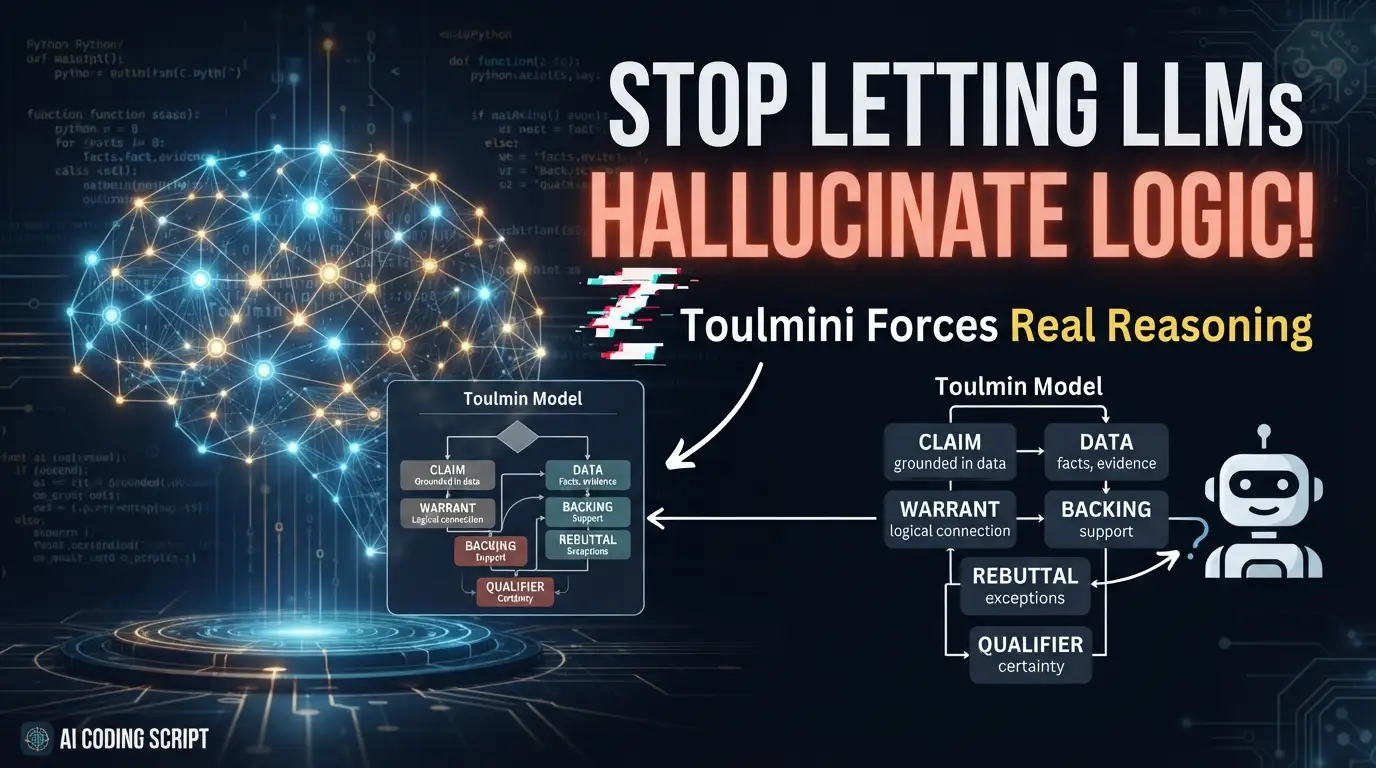
Stop Letting LLMs Hallucinate Logic! Toulmini Forces Real Reasoning
Your LLM just confidently explained why quantum computing proves astrology works. It sounded brilliant. Every sentence flowed. Every claim felt authoritative. And every single logical step was complete nonsense.
Sound familiar?
Here's the dirty secret nobody in AI wants to admit: large language models are world-class bullshitters. Not because they're malicious, but because they're optimized to sound right, not be right. They hedge when they should commit. They skip steps when rigor matters. They never, ever stress-test their own conclusions. The result? Convincing arguments built on logical sandcastles that collapse under the slightest scrutiny.
But what if you could force an LLM to think like a philosopher, a lawyer, and a scientist all at once? What if every claim had to be falsifiable, every warrant tested, every rebuttal confronted head-on?
Enter Toulmini—the open-source logic harness that's making developers rethink how AI should reason. No API keys. No black-box magic. Just brutal, beautiful, structured argumentation that terminates weak logic before it infects your decisions.
What is Toulmini?
Toulmini is an MCP-compatible server that wraps large language models in Stephen Toulmin's legendary argumentation framework. Created by developer Hmbown and released under the MIT license, this Python↗ Bright Coding Blog package transforms how AI systems construct, evaluate, and deliver arguments.
Stephen Toulmin, a British philosopher, developed his model in 1958 to analyze the practical structure of arguments beyond the rigid syllogisms of classical logic. Unlike formal logic that demands absolute certainty, Toulmin's model embraces the messy reality of real-world reasoning—claims backed by evidence, supported by warrants, qualified by uncertainty, and tested by counterarguments. It's the framework actual scientists, lawyers, and policymakers use when truth matters more than rhetorical polish.
Why Toulmini is trending now: The AI community is hitting a wall with "vibes-based" reasoning. Retrieval-augmented generation (RAG) helps with facts, but not with logic. Chain-of-thought prompting helps with transparency, but not with rigor. Developers are desperate for tools that enforce actual intellectual discipline—and Toulmini delivers exactly that through its four-phase execution pipeline with built-in circuit breakers.
The project is MCP (Model Context Protocol) compatible, meaning it integrates seamlessly with Claude Desktop, Claude Code, and any MCP-compliant client. Zero configuration friction. Zero API key management. Just pip install and your LLM suddenly develops intellectual integrity.
Key Features That Separate Toulmini from Toy Solutions
Toulmini isn't another wrapper that slaps a prompt template on GPT-4 and calls it "reasoning." It's a full logic architecture with mechanical enforcement of argumentative discipline.
Four-Phase Sequential Pipeline with Mandatory Gates: Every query traverses a rigid sequence: Data/Claim extraction → Warrant/Backing construction → Rebuttal/Qualifier stress-testing → Final Verdict. No skipping phases. No faking completion. The model literally cannot proceed without passing each gate.
Circuit Breakers That Kill Weak Arguments: This is where Toulmini gets brutal—and brilliant. If the warrant connecting evidence to claim is weak, the chain terminates immediately. If backing authority is missing or suspect, execution halts. If rebuttals are unaddressed, the argument dies before reaching verdict. Weak logic gets no mercy.
Five Specialized Tools for Complete Analysis:
The initiate_toulmin_sequence tool forces evidence extraction and claim construction. inject_logic_bridge builds and validates warrants with circuit-breaker enforcement. stress_test_argument launches adversarial attacks against the model's own reasoning. render_verdict delivers binary judgments: sustained, overruled, or remanded. Finally, format_analysis_report generates publication-ready markdown↗ Smart Converter documentation.
The Council: Multi-Perspective Reasoning: Before critical phases, Toulmini can convene simulated expert panels—bioethicists, medical geneticists, disability rights advocates, climate scientists, economists. Each perspective interrogates the argument from its disciplinary standpoint, surfacing blind spots that single-viewpoint reasoning misses.
Zero External Dependencies for Core Functionality: No API keys. No rate limits. No vendor lock-in. Toulmini runs locally as an MCP server, using your existing LLM infrastructure while enforcing its logical discipline externally.
Real-World Use Cases Where Toulmini Shines
1. Medical and Bioethical Decision Support
When analyzing whether to approve experimental gene therapies, pharmaceutical companies and hospital ethics boards need more than confident-sounding LLM summaries. Toulmini forces citation of actual evidence, explicit warrants connecting molecular mechanisms to clinical outcomes, mandatory rebuttal analysis (What if off-target effects emerge? What about equitable access?), and qualified verdicts with confidence levels. The circuit breaker prevents dangerous overreach when evidence is insufficient.
2. Policy Analysis and Legislative Drafting
Government agencies and think tanks use LLMs to analyze policy proposals, but standard outputs mix plausible rhetoric with hidden assumptions. Toulmini exposes every logical leap: What data supports the economic projection? What warrant connects the pilot program results to national scale? What rebuttals have proponents ignored? The consult_field_experts function surfaces perspectives from affected communities, economists, and implementation specialists before conclusions harden.
3. Scientific Literature Review and Meta-Analysis
Researchers drowning in papers need synthesis tools that don't hallucinate connections. Toulmini enforces: explicit data extraction from each study, falsifiable claims about findings, warrants explaining why Study A's methodology supports Claim B, backing from established theoretical frameworks, and systematic rebuttal of alternative interpretations. When warrant strength falls below threshold, the chain terminates—flagging areas needing primary research rather than false confidence.
4. Legal Argument Construction and Precedent Analysis
Law firms deploying AI for brief writing face malpractice risks from confident errors. Toulmini structures arguments like senior partners demand: evidence from cited precedents, warrants explaining why precedent applies to present facts, backing from jurisdictional authority, explicit rebuttal of opposing constructions, and qualified verdicts on argument strength. Circuit breakers prevent submission of arguments with untested logical foundations.
5. Investment Due Diligence and Risk Assessment
Venture capitalists and analysts use Toulmini to evaluate startup pitches and market opportunities. The tool forces explicit evidence for market size claims, warrants connecting traction metrics to scalability predictions, backing from comparable exits or established business models, and systematic rebuttal of bear cases. When confidence drops below 30%, verdict automatically shifts to "overruled" or "remanded"—preventing FOMO-driven decisions.
Step-by-Step Installation & Setup Guide
Getting Toulmini operational takes under five minutes. The project requires Python 3.10 or higher and installs cleanly via PyPI.
Installation
# Install from PyPI
pip install toulmini

# Verify installation
toulmini-cli --verify
The --verify flag runs a health check confirming the MCP server can initialize and all five tools are accessible.
Configuration for Claude Code
If you're using Anthropic's Claude Code CLI tool, add Toulmini as an MCP server with a single command:
claude mcp add toulmini -- python -m toulmini.server
This registers Toulmini with your Claude Code environment, making all five analysis tools available in conversational context.
Configuration for Claude Desktop
For Claude Desktop users, add the following to your MCP server configuration file:
{
  "mcpServers": {
    "toulmini": {
      "command": "python",
      "args": ["-m", "toulmini.server"]
    }
  }
}
Configuration file locations by operating system:
| Platform | Path |
|---|---|
| macOS | ~/Library/Application Support/Claude/claude_desktop_config.json |
| Windows | %APPDATA%\Claude\claude_desktop_config.json |
| Linux | ~/.config/Claude/claude_desktop_config.json |
CLI Helper Commands
Toulmini includes a convenience CLI for configuration management:
# Display current configuration
toulmini-cli --config

# Print MCP configuration snippet for manual installation
toulmini-cli --install -
Development Installation
For contributors or those wanting edge features:
git clone https://github.com/Hmbown/Toulmini.git
cd Toulmini
pip install -e ".[dev]"
pytest  # Run full test suite
The development install includes testing dependencies and documentation tools. See CONTRIBUTING.md for contribution guidelines.
REAL Code Examples from the Repository
Let's examine how Toulmini actually operates with concrete implementations from the project's documentation and examples.
Example 1: The Core Pipeline in Action
The simplest invocation happens through natural language after MCP configuration:
"Analyze this argument: Should we allow human genetic engineering?"
Behind the scenes, Toulmini executes its full four-phase pipeline automatically:
Query → Data/Claim → Warrant/Backing → Rebuttal/Qualifier → Verdict
         Phase 1        Phase 2            Phase 3          Phase 4
What's happening here: The natural language query triggers initiate_toulmin_sequence (Phase 1), which extracts evidence about genetic engineering applications and constructs a falsifiable claim. Then inject_logic_bridge (Phase 2) builds the logical warrant connecting evidence to claim—if this warrant fails validation, the circuit breaker terminates execution immediately. Only strong arguments reach stress_test_argument (Phase 3), where the model adversarially attacks its own reasoning. Finally, render_verdict (Phase 4) delivers sustained, overruled, or remanded based on surviving logical strength.
Example 2: The Council Multi-Perspective Function
For complex ethical or technical questions, convene expert perspectives before critical phases:
consult_field_experts(
    query="Should we allow genetic engineering?",
    perspectives=["Bioethicist", "Medical Geneticist", "Disability Rights Advocate"]
)
Deep dive: This function simulates domain-specific expertise without requiring actual expert access. Each perspective role-forces the LLM to adopt disciplinary frameworks: the Bioethicist applies principled reasoning (autonomy, beneficence, non-maleficence, justice), the Medical Geneticist evaluates technical feasibility and clinical evidence standards, and the Disability Rights Advocate tests for ableist assumptions and eugenic risks. These perspectives feed into Phase 2 or Phase 3, ensuring warrants and rebuttals reflect genuine multidisciplinary scrutiny rather than single-viewpoint confidence.
Example 3: MCP Server Configuration (JSON)
The server configuration reveals Toulmini's clean architecture:
{
  "mcpServers": {
    "toulmini": {
      "command": "python",
      "args": ["-m", "toulmini.server"]
    }
  }
}
Architecture insight: Toulmini runs as a standard Python module (-m toulmini.server), making it compatible with any MCP client that can execute Python processes. The server exposes five tools through the Model Context Protocol, enabling seamless integration without custom APIs or network configuration. This design choice means Toulmini works with Claude today, but will automatically support future MCP-compliant clients from OpenAI, Google, or open-source projects.
Example 4: CLI Verification and Configuration Inspection
# Health check - validates server initialization and tool availability
toulmini-cli --verify

# Display current runtime configuration
toulmini-cli --config

# Output installable MCP configuration snippet
toulmini-cli --install -
Operational pattern: These commands reveal Toulmini's production-readiness. The --verify flag is critical for CI/CD pipelines and monitoring—if the server fails health checks, dependent systems can fail gracefully rather than propagating errors. The --config output helps debug environment-specific issues (Python path, module availability, permission problems). The --install - flag outputs to stdout, enabling shell scripting and automated deployment scenarios.
Advanced Usage & Best Practices
Compose with RAG for Citation Quality: Toulmini's limitation notice is honest—without web search, citations come from training data and may be stale or hallucinated. The pro move: layer Toulmini over a RAG pipeline with verified document retrieval. Let your vector database supply fresh evidence, then let Toulmini enforce logical rigor on that evidence. This combination addresses both the factuality problem and the reasoning problem simultaneously.
Tune Circuit Breaker Sensitivity for Domain Risk: Medical and legal applications should use strict warrant validation—terminate on any backing weakness. Creative brainstorming or early-stage exploration might benefit from looser thresholds that surface more speculative chains. The circuit breaker isn't one-size-fits-all; configure its sensitivity to match consequence severity.
Chain Toulmini with Hegelion for Dialectical Depth: Hmbown's sister project Hegelion implements dialectical reasoning (thesis-antithesis-synthesis). Use Toulmini for rigorous single-argument construction, then Hegelion for multi-party debate between competing Toulmini-analyzed positions. This creates institutional-grade deliberation systems.
Monitor Failure Mode Patterns: Toulmini's documented failure modes reveal reasoning quality trends. If Phase 2 termination dominates, your evidence-to-claim connections need strengthening. If Phase 3 rebuttals consistently overwhelm arguments, your initial framing may be biased. Track these patterns to improve your query engineering.
Use Format Analysis Report for Audit Trails: The optional Phase 5 markdown report isn't cosmetic—it's compliance infrastructure. In regulated industries, these reports provide auditable documentation of how AI systems reached conclusions, with explicit logical structure for regulatory examination.
Comparison with Alternatives
| Capability | Standard CoT Prompting | RAG Systems | Toulmini |
|---|---|---|---|
| Logical structure enforcement | ❌ None | ❌ None | ✅ Mandatory 4-phase pipeline |
| Circuit breakers for weak reasoning | ❌ None | ❌ None | ✅ Automatic termination |
| Adversarial self-testing | ❌ None | ❌ None | ✅ Built-in stress_test_argument |
| Multi-perspective reasoning | ⚠️ Manual prompt engineering | ❌ None | ✅ consult_field_experts tool |
| Falsifiable claim requirement | ❌ None | ❌ None | ✅ Phase 1 enforcement |
| Verdict qualification | ⚠️ Inconsistent | ❌ None | ✅ sustained/overruled/remanded |
| API key requirement | Varies | Usually required | ❌ None for core functionality |
| MCP compatibility | ❌ None | ❌ None | ✅ Native |
Why Toulmini wins: Chain-of-thought prompting reveals reasoning steps but doesn't validate their quality. RAG grounds responses in documents but doesn't enforce logical connections between them. Toulmini is the only open-source solution that mechanically enforces argument quality through structural constraints, with termination as the ultimate penalty for sloppy thinking.
FAQ: Developer Concerns Addressed
Q: Does Toulmini require OpenAI, Anthropic, or other paid API keys? A: No. Toulmini runs as a local MCP server using your existing LLM infrastructure. It enforces logical discipline externally, regardless of which model generates the underlying text.
Q: Which LLMs work best with Toulmini? A: Any model accessible through your MCP client. Stronger base models (Claude 3.5 Sonnet, GPT-4, Llama 3.1 70B) produce more sophisticated warrants and rebuttals, but Toulmini's structural enforcement improves reasoning quality across all model tiers.
Q: Can I customize the circuit breaker thresholds? A: The repository's configuration system supports sensitivity adjustment. Check the docs for domain-specific tuning guidance.
Q: What happens when Toulmini terminates at Phase 2? A: The analysis returns with explicit feedback: which warrant failed, why backing was insufficient, and what evidence would be needed to proceed. This is a feature, not a bug—it prevents false confidence.
Q: Is Toulmini production-ready for regulated industries? A: The MIT-licensed codebase includes comprehensive tests and clear limitations documentation. The Phase 5 markdown reports support audit requirements. However, as with any AI tool, implement appropriate human oversight for high-stakes decisions.
Q: How does Toulmini relate to formal verification or theorem proving? A: Toulmini enforces argument structure, not mathematical proof. It's designed for real-world reasoning where absolute certainty is impossible—exactly where classical logic fails and Toulmin's model succeeds.
Q: Can I contribute new expert perspective types? A: Absolutely. The CONTRIBUTING.md guidelines welcome domain-specific perspective expansions, additional circuit breaker implementations, and client integrations.
Conclusion: The Era of Vibes-Based AI Reasoning Is Ending
We've tolerated LLMs that sound smart while reasoning poorly because we lacked alternatives. That era is over.
Toulmini represents a fundamental shift: from hoping models reason well to mechanically ensuring they do. Its four-phase pipeline with circuit breakers, adversarial self-testing, and multi-perspective consultation creates argumentation standards that would make philosophy professors proud—and risk managers relieved.
The beauty is in the simplicity. One pip install. One MCP configuration. And suddenly every argument your AI produces has been stress-tested, rebuttal-checked, and warrant-validated before reaching your eyes.
For developers building systems where decisions matter—medical, legal, financial, policy—Toulmini isn't optional. It's infrastructure. The question isn't whether you can afford the slight latency of rigorous reasoning. It's whether you can afford the catastrophic costs of confident nonsense.
Star Toulmini on GitHub. Install it today. Force your LLM to think before it speaks. Your users—and your liability insurance—will thank you.
Ready to explore deeper? Check out Hegelion, Toulmini's dialectical reasoning sister project, for multi-party debate systems.