Gremble-io/Tome: On-Device Meeting Capture for Apple Silicon
Developers, consultants, and knowledge workers who rely on structured note-taking systems face a persistent capture problem: meetings generate valuable information, but manual transcription is slow, and cloud-based tools create privacy risks and workflow friction. Most transcription services lock data in proprietary formats, require internet connectivity, and cannot feed directly into personal knowledge management systems like Obsidian vaults. Gremble-io/Tome solves this by running entirely on Apple Silicon Macs, converting speech to structured markdown↗ Smart Converter without network traffic, and producing vault-native output that integrates with agent workflows.
What is Gremble-io/Tome?
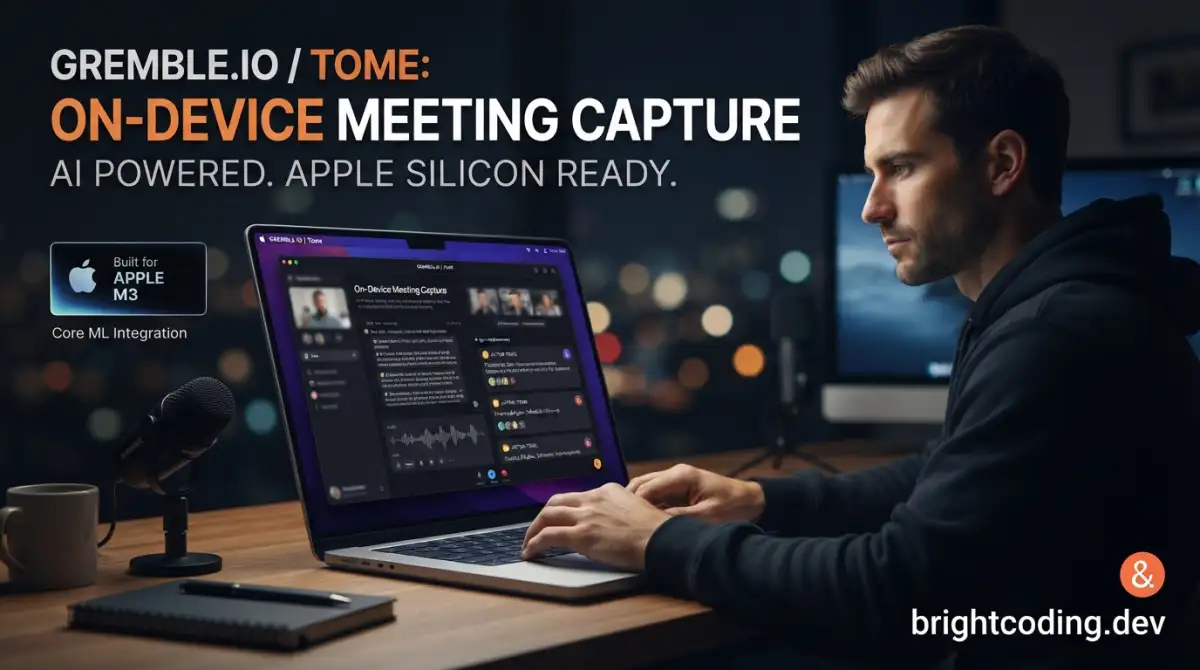
Gremble-io/Tome (branded as Detto in its current release) is a macOS application for Apple Silicon that performs on-device meeting capture, dictation, and voice memo transcription. The project is maintained by Gremble-io and has accumulated 509 GitHub stars and 26 forks as of its last commit on June 10, 2026. Written primarily in Swift 6.2, it targets macOS 26+ and requires Apple Silicon hardware.
The tool emerged from a consultant's specific need: capturing client calls and feeding structured transcripts into an Obsidian second-brain system with YAML frontmatter, backlinks, and automated agent processing. The maintainer evaluated Otter, Granola, and Fireflies before building Tome/Detto, finding that none offered offline operation, plain markdown output, or direct vault integration.
The project operates under a dual-license structure. The application itself uses the Business Source License 1.1 (BSL 1.1), permitting personal use and modification while restricting commercial redistribution as a competing product; this license converts automatically to MIT on May 12, 2030. The underlying GrembleVoice speech engine is open source under Apache 2.0.
Key Features
Local-First Architecture. After initial model downloads, all processing occurs on-device. ASR runs on the Apple Neural Engine via Parakeet-TDT v3. Text refinement uses Llama 3.2 3B (4-bit quantized) through MLX on the GPU. No audio leaves the Mac, and no audio is saved to disk—buffers exist in memory during sessions and are discarded immediately after transcription.
Vault-Native Output. Every transcript generates as a plain .md file with YAML frontmatter, ready for Obsidian, VS Code, or automated agent pipelines. No export step, no proprietary lock-in.
Three Capture Modes. Call Capture records microphone and system audio simultaneously with channel-based speaker separation ("You" vs. "Them"). Voice Memo captures single-speaker audio to a separate folder. Dictation provides system-wide hotkey-activated transcription that injects text at the cursor position in any application.
Client Briefing Integration. When pointed at a vault root, Tome scans for markdown files with type: client frontmatter and surfaces contacts, priorities, and timeline information in a pre-call briefing panel. Selected client context embeds automatically into transcript output.
Conferencing App Detection. Automatic identification of active meeting applications (Teams, Zoom, Slack, Webex, Google Meet) tags transcript metadata accordingly.
Privacy-by-Design. No server, no account, no analytics SDK. Optional Sparkle update checks against a static GitHub Pages XML file represent the only network activity after setup.
Use Cases
Consultant Workflow Automation. A consultant maintains client files in an Obsidian vault with structured YAML frontmatter. Before each call, Tome surfaces the client's key contacts and current priorities. During the call, it captures both sides of the conversation with speaker labels. Afterward, the structured markdown file drops into the vault where automated agents extract action items, update client files, and connect related notes.
Developer Documentation by Voice. A developer needs to capture architectural decisions or code review discussions without breaking flow. System-wide dictation allows speaking naturally in Slack, email, or documentation tools, with GPU-accelerated refinement cleaning up punctuation and capitalization offline.
Field Research and Interviews. A researcher conducts sensitive interviews requiring confidentiality guarantees. On-device processing eliminates data residency concerns. The 25 European languages auto-detected by ASR support multilingual work, though the Llama refiner is English-tuned.
Personal Knowledge Capture. Quick voice memos during commutes or between tasks capture fleeting thoughts in structured format, preventing idea loss without manual transcription overhead.
Installation & Setup
Prebuilt Binary:
Download the latest DMG from the Releases page. The application is signed and notarized; drag to Applications.
Build from Source:
git clone https://github.com/Gremble-io/detto.git
cd detto
./scripts/build_swift_app.sh
System Requirements:
- Apple Silicon Mac (no Intel support)
- macOS 26 or later
- Xcode 26.3+ for source builds
First Launch:
The application downloads two models on initial startup:
- Parakeet ASR: approximately 600MB
- Llama 3.2 3B: approximately 2GB
Both are cached locally after download.
Required Permissions:
| Permission | When Required | Purpose |
|---|---|---|
| Microphone | All modes | Voice capture |
| Screen Recording | Call Capture only | System audio via ScreenCaptureKit |
| Accessibility | Dictation only | Cursor-position text injection |
All permissions are requested during onboarding.
Vault Configuration:
Create .detto.yaml in your vault root:
clientsPath: Clients
clientType: client
sections:
  contacts: Key Contacts
  priority: Priority Item
  timeline: Operational Timeline
Defaults work if client files live in Clients/ with the headings above.
Real Code Examples
Example 1: Custom Vocabulary File
The README documents a vocabulary correction format for domain-specific terms:
# Terms - canonical spelling, applied via case normalization + fuzzy match
PostgreSQL↗ Bright Coding Blog
San Francisco

# Corrections - pattern on left, replacement on right
Post Grass = PostgreSQL
This file is placed in a folder pointed to by Settings → Vocabulary → Custom Vocabulary. The bundled Canadian Politics pack demonstrates the format for fixing common ASR errors. The ExampleVocabulary/ directory in the repository contains a working reference file.
Example 2: Generated Transcript Output
The following represents actual output format from the README:
---
type: meeting
created: "2026-05-12"
time: "10:00"
duration: "18:42"
source_app: "Zoom"
source_file: "2026-05-12 10-00-00 Acme Corp.md"
attendees: ["You", "Them"]
context: "Client: Acme Corp"
tags:
  - log/meeting
  - status/inbox
  - source/meeting
  - source/detto
---

# Call Recording - 2026-05-12 10:00

**Duration:** 18:42 | **Speakers:** 2

---

## Context

**Client:** Acme Corp

### Key Contacts
- Jane Smith, VP Engineering
- Mike Chen, Product Lead

### Priority
- Q3 launch timeline at risk, waiting on vendor API

### Notes
Discuss revised timeline and fallback plan for vendor delay.

---

## Transcript

**You** (10:00:03)
Morning. Quick sync on the product launch. Where are we at?

**Them** (10:00:07)
We're in good shape. QA signed off yesterday, marketing assets
are locked, landing page is live in staging.
Voice memos use type: fleeting with single-speaker format. The YAML frontmatter enables automated processing by Obsidian plugins, Python↗ Bright Coding Blog scripts, or [INTERNAL_LINK: agent-workflows-for-knowledge-management].
Advanced Usage & Best Practices
Hotkey Optimization. Dictation supports multiple activation styles: hold-to-speak for quick bursts, toggle mode (double-tap) for extended dictation. The floating pill overlay provides visual feedback without disrupting focus. Configure in Settings based on your typical usage patterns.
GPU Cache Pre-Warming. During dictation, Tome pre-warms the MLX GPU cache while you speak, enabling near-instant refinement upon key release. This architectural choice favors perceived responsiveness over minimal resource usage—acceptable for a dedicated workstation scenario.
Vault Structure Alignment. The .detto.yaml configuration is designed to adapt to existing vault structures rather than imposing organization. Match the sections mapping to your current client file headings to avoid restructuring.
Silence Handling. The 120-second auto-stop prevents runaway recordings but may interrupt thinking pauses. For extended contemplation during voice memos, consider toggle mode with manual stop.
Screen Sharing Visibility. Hidden by default; toggle in Settings if you need to demonstrate the tool during presentations.
Comparison with Alternatives
| Feature | Gremble-io/Tome | Otter.ai | WhisperKit CLI |
|---|---|---|---|
| Offline operation | Yes | No | Yes |
| Markdown output | Native | Export required | Requires scripting |
| Speaker separation | Channel-based (2) | Cloud diarization | Manual configuration |
| Vault integration | Built-in briefing | None | None |
| Refinement | Local Llama 3.2 3B | Cloud LLM | None |
| Platform | macOS 26+ Apple Silicon | Cross-platform | macOS/iOS |
| Cost | Free (BSL 1.1) | Subscription | Open source |
Otter.ai offers superior polish and team features but requires cloud connectivity and locks data in its platform. WhisperKit provides raw ASR for developers comfortable building pipelines. Tome occupies a specific niche: individuals who prioritize privacy, use Apple Silicon, and want integrated knowledge management without infrastructure work.
FAQ
Does Tome work on Intel Macs? No. Apple Silicon is required for Neural Engine ASR and MLX GPU acceleration.
What languages does ASR support? 25 European languages auto-detected, but the Llama refiner is English-tuned. Other languages transcribe without polish improvements.
How much storage do models require? Approximately 2.6GB total after first launch: 600MB for Parakeet ASR, 2GB for Llama 3.2 3B.
Can I use my own cloud transcription? The GrembleVoice engine includes a GrembleVoiceCloud module for BYOK cloud options (Claude, OpenAI, Groq), but the Detto app focuses on local operation.
Is there a team or multi-user version? No. Single-user personal tool by design.
How does licensing affect commercial use? BSL 1.1 permits personal use and modification. Commercial redistribution as a competing product is restricted until the MIT conversion date of May 12, 2030.
Does audio persist anywhere? No. Audio buffers are memory-only and discarded after each session. Only text transcripts are retained.
Conclusion
Gremble-io/Tome targets a specific profile: Apple Silicon users who value privacy, work extensively in markdown-based knowledge systems, and need frictionless capture without cloud dependencies. The 509-star project reflects genuine utility for this niche rather than mass-market appeal.
The tool makes deliberate trade-offs. It sacrifices the polish of frontier cloud models for data ownership. It limits platform support to optimize for Neural Engine and MLX performance. It omits team features to maintain architectural simplicity.
For consultants, researchers, and developers already invested in Obsidian or similar vault systems, Tome eliminates the capture-to-structure gap that breaks most transcription workflows. The vault-native output and client briefing integration demonstrate thoughtful design around real usage patterns rather than generic feature accumulation.
Explore the repository, review the source, and evaluate whether your workflow matches the tool's assumptions. The code is available at https://github.com/Gremble-io/Tome.