
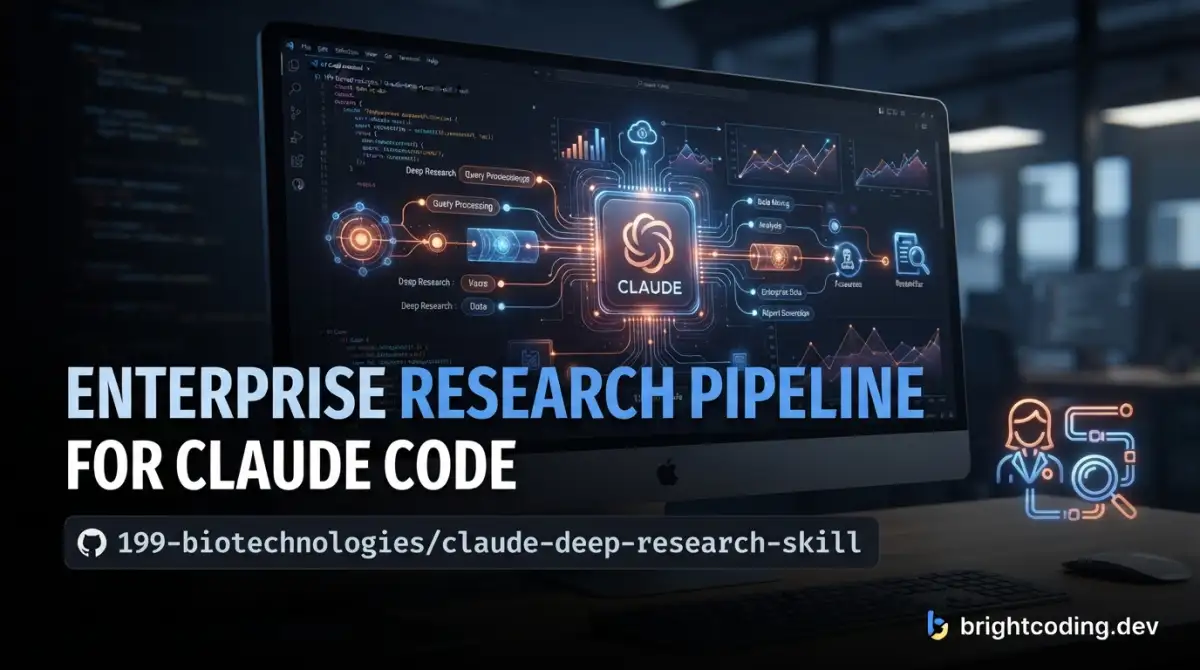
199-biotechnologies/claude-deep-research-skill: Enterprise Research Pipeline for Claude Code
Developers and technical teams increasingly rely on AI assistants for research tasks, but face a persistent problem: unverified claims, stale training data, and citations that evaporate when you need them. When you're evaluating database migrations, comparing cloud providers, or assessing emerging frameworks, a hallucinated source or outdated assumption can derail critical decisions. The claude-deep-research-skill from 199-biotechnologies addresses this gap directly—an enterprise-grade research engine that runs inside Claude Code with structured validation, source credibility scoring, and disk-persisted citations that survive context windows.
What is 199-biotechnologies/claude-deep-research-skill?
claude-deep-research-skill is an open-source skill extension for Claude Code, Anthropic's terminal-based coding assistant. Maintained by 199-biotechnologies, it transforms Claude from a conversational AI into a systematic research engine with an 8-phase pipeline, parallel retrieval, and automated quality gates.
With 932 GitHub stars and 97 forks as of its last commit on April 11, 2026, the project has gained meaningful traction among developers who need more rigor than standard AI chat provides. The repository is primarily Python↗ Bright Coding Blog-based and distributed under the MIT license (though the README notes "License: Not specified" in the repo metadata, the license section explicitly states MIT).
The tool sits at the intersection of several growing categories: AI-assisted research, developer productivity tooling, and structured knowledge pipelines. Its relevance stems from a specific architectural bet: rather than treating research as a single prompt-response cycle, it implements a multi-phase workflow with feedback loops, quality thresholds, and persistent state—design patterns borrowed from formal research methodologies rather than casual chat interfaces.
Key Features
8-Phase Research Pipeline The core architecture follows a strict sequence: Scope → Plan → Retrieve → Triangulate → Outline Refinement → Synthesize → Critique (with loop-back) → Refine → Package. The Critique phase can return to Retrieve with delta-queries if critical gaps emerge—a design that prevents the common failure mode of AI research tools that commit to an outline before discovering contradictory evidence.
Parallel Retrieval with Quality Controls The Retrieve phase executes 5-10 concurrent searches alongside 2-3 focused sub-agents returning structured evidence objects. An adaptive "First Finish Search" mechanism adjusts quality thresholds by research mode (Quick, Standard, Deep, UltraDeep), balancing thoroughness against time constraints.
Source Credibility & Validation
Every report undergoes automated validation through validate_report.py (9 structural checks) and verify_citations.py (DOI/URL/hallucination detection). A validation loop runs validate → fix → retry for up to 3 cycles. Sources receive credibility scores, and the tool enforces 10+ sources with 3+ per major claim.
Multi-Persona Red Teaming Deep and UltraDeep modes deploy three specialized personas—Skeptical Practitioner, Adversarial Reviewer, and Implementation Engineer—to stress-test findings before finalization.
Persistent Citations & Auto-Continuation
Citations write to sources.json on disk, surviving Claude Code's context compaction and continuation agents. Reports exceeding 18,000 words auto-continue via recursive agent spawning with context preservation.
Multi-Format Output
Final reports generate as Markdown↗ Smart Converter (primary), HTML (McKinsey-style, auto-opened in browser), and PDF (via WeasyPrint), saved to ~/Documents/[Topic]_Research_[Date]/.
Use Cases
Technology Stack Evaluation
The README's own example—deep research in ultradeep mode: compare PostgreSQL↗ Bright Coding Blog vs Supabase for our stack—illustrates the primary use case. Teams making infrastructure decisions need structured comparison with verified sources, not opinionated chat responses. The 8-phase pipeline ensures conflicting evidence surfaces before commitment.
Emerging Field Surveillance
The quantum computing example (deep research on the current state of quantum computing) demonstrates monitoring rapidly evolving domains. The Step 0 date retrieval prevents the common failure mode of AI models defaulting to stale training-data assumptions about "current" developments.
Due Diligence & Vendor Assessment The credibility scoring and multi-source requirements (10+ sources, 3+ per claim) make the tool suitable for evaluating vendors, open-source projects, or technical partnerships where unsupported claims carry real risk.
Long-Form Technical Documentation The auto-continuation system and progressive file assembly support reports exceeding 18,000 words—useful for architecture decision records (ADRs), technology radar entries, or internal research wikis where completeness matters more than speed.
Regulatory & Compliance Research
The validation scripts (verify_citations.py's hallucination detection, DOI verification) provide audit-trail confidence that standard AI chat cannot offer for compliance-sensitive domains.
Installation & Setup
Basic Installation
The skill installs directly into Claude Code's skills directory with no additional dependencies:
# Clone into Claude Code skills directory
git clone https://github.com/199-biotechnologies/claude-deep-research-skill.git ~/.claude/skills/deep-research
This command places the skill where Claude Code discovers and loads it automatically. The ~/.claude/skills/ path is Claude Code's standard extension point; no further configuration is required for basic functionality.
Optional: Multi-Provider Search via search-cli
For aggregated search across Brave, Serper, Exa, Jina, and Firecrawl, install the companion search-cli tool:
# Add the 199-biotechnologies tap and install search-cli
brew tap 199-biotechnologies/tap && brew install search-cli

# Configure at least one search provider API key
search config set keys.brave YOUR_KEY
The search-cli integration is the primary search path; Claude Code's built-in WebSearch serves as fallback if search-cli fails or hits rate limits. An optional Exa MCP integration provides semantic/neural search alongside search-cli.
Why this two-tier setup matters: The basic installation works immediately with Claude Code's native web search, but search-cli unlocks parallel queries across multiple search providers—critical for the 5-10 concurrent searches the Deep and UltraDeep modes expect. Without it, retrieval throughput drops significantly.
Real Code Examples
The README documents two primary interaction patterns. These are reproduced exactly as documented:
Standard Research Query
deep research on the current state of quantum computing
This triggers the default research mode (Standard: 6 phases, 5-10 minutes). The natural-language interface means no flag memorization—Claude Code parses the intent and selects appropriate pipeline parameters.
Mode-Specified Deep Research
deep research in ultradeep mode: compare PostgreSQL vs Supabase for our stack
The ultradeep mode prefix activates the full 8+ phase pipeline with multi-persona red teaming, targeting 20-45 minutes of processing. The colon-separated structure allows topic embedding without escaping complexity.
What happens under the hood: Both commands invoke the SKILL.md entry point (~100 lines), which delegates to research_engine.py for orchestration. The engine selects phase count, parallelism, and quality thresholds from the mode table, then executes the pipeline with disk-persisted state at each checkpoint.
Validation Scripts (Post-Generation)
After report generation, developers can run standalone validation:
# 9-check structural validation
python scripts/validate_report.py

# Citation verification: DOI, URL, hallucination detection
python scripts/verify_citations.py
These are not invoked automatically in all configurations; the README documents them as part of the quality standard but leaves integration flexibility to the user.
Advanced Usage & Best Practices
Match Mode to Decision Stakes: The Quick mode (3 phases, 2-5 minutes) suits initial exploration where you'll likely discard the output. Reserve Deep/UltraDeep for irreversible decisions—database migrations, vendor lock-in, architectural commitments. The time investment (10-45 minutes) is justified when the cost of being wrong exceeds the cost of thoroughness.
Configure Multiple Search Providers: The search-cli setup supports multiple keys. Configuring Brave + Exa + Serper provides redundancy if one provider rate-limits or returns degraded results during parallel retrieval. The fallback to WebSearch is functional but lacks the aggregation logic that makes multi-source triangulation reliable.
Monitor sources.json for Continuity: The disk-persisted citations aren't merely archival—they enable continuation agents to resume without re-retrieving sources. For long-running UltraDeep reports, verify this file exists and has non-zero size before interrupting sessions.
Validate Before Distributing: The validation scripts (validate_report.py, verify_citations.py) are designed for integration into CI-like workflows. Consider wrapping them in a pre-commit or pre-publish hook if your team generates research for external consumption.
Opinion: The 18,000-word auto-continuation threshold suggests a design assumption that most research tasks complete below this boundary. For routine evaluations, if you're consistently hitting continuation, consider whether the topic scope is too broad or the UltraDeep mode is overkill.
Comparison with Alternatives
| Dimension | claude-deep-research-skill | OpenAI Deep Research | Claude Desktop (Native) | Perplexity Pro |
|---|---|---|---|---|
| Pipeline Structure | 8-phase with loop-back | Proprietary, undisclosed | Single-turn or limited multi-turn | Search + synthesis |
| Source Persistence | Disk (sources.json) |
Session-bound | Session-bound | Partial export |
| Validation | Automated 9-check + citation verify | Undisclosed | None automated | Limited |
| Red Teaming | 3 personas (Deep/UltraDeep) | None disclosed | None | None |
| Integration | Claude Code terminal | Web UI | Desktop app | Web/app |
| Customization | Full source (MIT), modifiable | Closed | Closed | Closed |
| Speed Control | 4 explicit modes | Single speed | N/A | Fast/slow toggle |
Trade-offs to consider: OpenAI's Deep Research and Perplexity Pro require no installation and offer polished UIs, but lack the transparency, persistence, and customization of an open-source pipeline. Claude Desktop provides the same underlying model without the structured methodology. The claude-deep-research-skill demands terminal comfort and manual setup (especially search-cli configuration) in exchange for auditability and integration into developer workflows.
FAQ
Does this work with Claude Desktop or only Claude Code?
The skill installs into ~/.claude/skills/, which is Claude Code's extension path. Claude Desktop does not support this mechanism.
What Python version is required? The README does not specify; the repository is Python-based but lacks explicit version constraints in the documented installation.
Is the MIT license confirmed? The README's "License" section states MIT, though repo metadata shows "Not specified." The explicit declaration in documentation takes precedence.
Can I use this without search-cli?
Yes—Claude Code's built-in WebSearch serves as fallback. However, parallel retrieval and multi-provider aggregation require search-cli.
How does the critique loop-back work? Phase 6 (Critique) can return to Phase 3 (Retrieve) with delta-queries if critical gaps are found, up to the mode's quality threshold.
Are reports shareable outside the generating system?
Yes—Markdown, HTML, and PDF outputs are standard formats. sources.json travels with the report directory for citation verification.
What happens if validation fails after 3 cycles?
The README does not specify failure behavior beyond the max-3-cycles limit; inspect research_engine.py for implementation details.
Conclusion
The claude-deep-research-skill from 199-biotechnologies fills a specific niche: developers who need structured, verifiable research output from AI assistance, not just conversational answers. Its 8-phase pipeline with feedback loops, source persistence, and automated validation addresses genuine failure modes in standard AI research tools—hallucinated citations, stale assumptions, and lost context.
This tool is best suited for technical decision-makers evaluating infrastructure, engineering teams producing architecture documentation, and researchers in fast-moving fields where source quality matters. It is not a drop-in replacement for quick web searches or casual information gathering—the setup overhead and processing time only pay off for high-stakes decisions.
The 932-star traction suggests real adoption among developers prioritizing rigor over convenience. If your workflow already centers Claude Code and you regularly produce research for team consumption, the installation is low-friction and the open-source license permits customization for internal standards.
Explore the repository, review the methodology documentation, and install the skill at https://github.com/199-biotechnologies/claude-deep-research-skill.