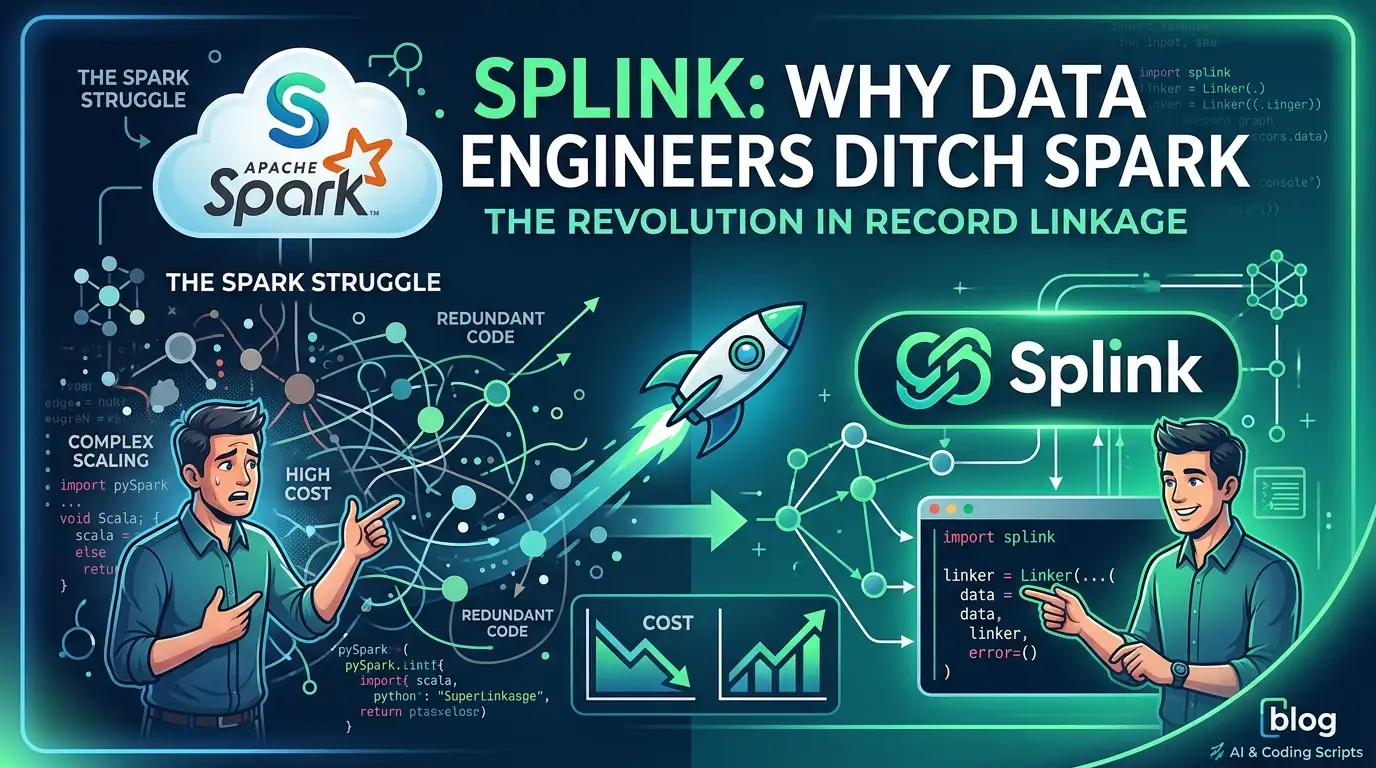
Splink: Why Data Engineers Ditch Spark for Record Linkage
What if I told you that linking a million customer records—finding duplicates, merging datasets, building golden master records—could take less than 60 seconds on your laptop? No Spark cluster. No cloud bill. No weeks of infrastructure setup.
Sounds impossible, right? That's exactly what most data engineers think when they first encounter probabilistic record linkage problems. They've been conditioned to reach for heavyweight distributed systems, complex entity resolution platforms, or expensive commercial tools the moment their datasets cross into the millions of rows.
But here's the dirty secret the big data vendors don't want you to know: most record linkage workloads don't need a cluster. They need a smarter algorithm.
Enter Splink—the open-source Python↗ Bright Coding Blog library that's quietly becoming the weapon of choice for data scientists at the UK's Ministry of Justice, the Office for National Statistics, and an exploding community of practitioners. Built on decades of statistical theory but designed for modern data workflows, Splink is redefining what's possible when you need to deduplicate records, link datasets without shared keys, or build unified customer views.
In this deep dive, I'll expose why Splink is leaving traditional approaches in the dust, walk you through exactly how it works, and show you production-ready code you can run today. Whether you're battling duplicate patient records, merging CRM databases, or building a single source of truth from fragmented data sources—this is the tool you've been missing.
What Is Splink?
Splink is a Python package for probabilistic record linkage (also known as entity resolution) developed by the Ministry of Justice Analytical Services in the United Kingdom. It allows you to deduplicate and link records from datasets that lack unique identifiers—the kind of messy, real-world data that makes traditional SQL joins completely useless.
The project emerged from a concrete government need: linking administrative justice system data where no reliable person ID existed across different databases. Funded initially by ADR UK (Administrative Data Research UK) through the Data First project, Splink has evolved into a production-grade tool that's now used across government, academia, and the private sector worldwide.
What makes Splink genuinely special is its foundation in Fellegi-Sunter's model of record linkage—a statistical framework developed in 1969 that's been battle-tested in census operations and national statistics for over 50 years. But Splink isn't just a academic implementation. The team has modernized this approach with critical customizations: term frequency adjustments that account for common names like "John Smith," user-defined fuzzy matching logic that handles typos and variations, and unsupervised learning that eliminates the need for labeled training data.
The project's credibility is hard to ignore. It won the Civil Service Awards 2025 Innovation category, the OpenUK Awards 2025 Open Data category, and has been recognized multiple times for innovative methods in government analytics. When national statistical offices trust Splink for census linkage operations, you know this isn't toy software.
Splink 4, released in mid-2024, represents a major evolution with cleaner syntax, enhanced DuckDB integration, and streamlined APIs that make complex linkage workflows significantly more approachable.
Key Features That Separate Splink from the Pack
Let's dissect what makes Splink genuinely powerful for real-world data problems:
⚡ Blazing Speed on Modest Hardware Splink can link a million records on a laptop in approximately one minute. This isn't marketing fluff—it's achieved through DuckDB's vectorized execution engine and intelligent blocking strategies that avoid the O(n²) comparison nightmare. For truly massive datasets, the same code scales to AWS↗ Bright Coding Blog Athena or Spark for 100+ million records without architectural rewrites.
🎯 Statistical Rigor Meets Practical Flexibility The accuracy story goes beyond basic string matching. Splink implements:
- Term frequency adjustments: Automatically downweights common values (like "London" for city or "Smith" for surname) that would otherwise generate false positives
- Configurable fuzzy matching: Jaro-Winkler, Jaro distance, and custom comparison thresholds per field
- Date of birth intelligence: Special handling for transposed day/month, year mismatches, and partial dates
- Email comparison logic: Domain-level and username-level matching with built-in parsing
🌐 Backend Agnostic Architecture Write your linkage logic once, run it anywhere. Splink abstracts the SQL generation layer, supporting:
- DuckDB (default, fastest for <10M records)
- Apache Spark (distributed, existing cluster leverage)
- AWS Athena (serverless, pay-per-query)
- PostgreSQL↗ Bright Coding Blog (existing database infrastructure)
🎓 True Unsupervised Learning Here's where Splink fundamentally diverges from machine learning approaches: zero training data required. The Expectation-Maximization algorithm estimates model parameters directly from your data's statistical properties. No hand-labeling thousands of record pairs. No brittle supervised models that fail when data distributions shift.
📊 Interactive Diagnostic Visualizations Splink ships with a suite of interactive dashboards—Comparison Viewer, Match Weight Histograms, Waterfall Charts—that let you diagnose why records matched, identify threshold tuning opportunities, and build stakeholder confidence in your linkage quality.
Where Splink Absolutely Dominates: Real Use Cases
1. Government Administrative Data Integration
The original killer app. When the UK's Office for National Statistics linked 2021 Census data to itself, they used Splink to resolve identities without a national ID card system. Multiple government departments now use it to join health, education, and justice records while preserving privacy.
2. Healthcare Patient Master Index Creation
Hospitals and health systems struggle with the same patient registered under slightly different names, addresses, or with data entry errors. Splink's probabilistic approach handles "Elizabeth Smith" vs "Liz Smyth" at 123 Main St vs 123 Main Street—matches that deterministic rules miss entirely.
3. CRM Deduplication and Customer 360
Marketing operations drowning in duplicate contacts from form submissions, acquisitions, and data imports. Splink identifies that "Acme Corp" and "Acme Corporation Ltd" with the same phone number are the same entity, even when your CRM's built-in deduplication fails.
4. Financial Services KYC and Anti-Fraud
Banks and fintechs need to identify whether a new applicant matches known entities in sanctions lists, PEP databases, or previous fraud records. Splink's explainable match weights provide audit trails that black-box ML models cannot.
5. Academic Research and Longitudinal Studies
Linking survey responses across waves, matching birth records to later educational outcomes, or constructing family histories from fragmented archives. The unsupervised nature is crucial when historical ground truth simply doesn't exist.
Step-by-Step Installation & Setup Guide
Getting Splink running takes under five minutes. Here's the complete setup:
Basic Installation (DuckDB Backend)
Splink requires Python 3.9 or higher. The minimal installation uses DuckDB, which is now the recommended default for most workloads:
# Standard PyPI installation
pip install splink

# Or using conda
conda install -c conda-forge splink
This gives you the full Splink functionality with DuckDB as the execution engine—sufficient for datasets up to roughly 10 million records on standard hardware.
Backend-Specific Installations
For larger-scale or existing infrastructure integration:
# Apache Spark (distributed processing)
pip install 'splink[spark]'

# AWS Athena (serverless, S3-based)
pip install 'splink[athena]'

# PostgreSQL (existing database)
pip install 'splink[postgres]'
Environment Verification
Confirm your installation:
import splink
print(splink.__version__)

# Test DuckDB availability
from splink import DuckDBAPI
api = DuckDBAPI()
print("DuckDB backend ready")
Critical Configuration Notes
- Memory: DuckDB automatically uses available RAM; for datasets approaching your machine's limit, increase swap or switch to Spark
- JVM Required for Spark: Ensure Java 8 or 11 is installed before using the Spark backend
- AWS Credentials for Athena: Configure standard boto3 credential chain (environment variables, ~/.aws/credentials, or IAM roles)
Real Code Examples: From Zero to Linked Data
Let's walk through Splink's complete workflow using the actual code from the repository's quickstart. This isn't simplified pseudo-code—this is production-ready Python that you can execute immediately.
Example 1: Complete Deduplication Pipeline
This example demonstrates the full lifecycle: configuration, training, prediction, and clustering.
import splink.comparison_library as cl
from splink import DuckDBAPI, Linker, SettingsCreator, block_on, splink_datasets

# Initialize the DuckDB execution engine—this is where the heavy lifting happens
db_api = DuckDBAPI()

# Load built-in synthetic dataset for demonstration
# In production, replace with: pd.read_csv("your_data.csv") or similar
df = splink_datasets.fake_1000

# Configure the linkage model with field-specific comparison strategies
settings = SettingsCreator(
    link_type="dedupe_only",  # We're finding duplicates within one dataset
    comparisons=[
        # Fuzzy name matching: Jaro-Winkler with thresholds at 0.9 and 0.7
        # Records scoring above 0.9 are 'exact enough', below 0.7 are 'definitely different'
        cl.JaroWinklerAtThresholds("first_name", [0.9, 0.7]),

        # Surname with standard Jaro distance—slightly different string metric
        cl.JaroAtThresholds("surname", [0.9, 0.7]),

        # Intelligent date handling: allows 1 year or 1 month difference
        # input_is_string=True handles common "YYYY-MM-DD" string formats
        cl.DateOfBirthComparison(
            "dob",
            input_is_string=True,
            datetime_metrics=["year", "month"],
            datetime_thresholds=[1, 1],
        ),

        # Exact city match WITH term frequency adjustment
        # This downweights matches on common cities like "London"
        cl.ExactMatch("city").configure(term_frequency_adjustments=True),

        # Built-in email comparison: handles username similarity and domain matching
        cl.EmailComparison("email"),
    ],
    # Blocking rules: these dramatically reduce comparison space
    # We only compare records sharing first_name OR surname
    # This avoids comparing all 1,000,000² possible pairs
    blocking_rules_to_generate_predictions=[
        block_on("first_name"),
        block_on("surname"),
    ]
)

# Create the linker: this compiles your settings into executable SQL
linker = Linker(df, settings, db_api)
Example 2: Unsupervised Model Training
Now we train the probabilistic model—no labeled data required:
# Step 1: Estimate probability that two RANDOM records match
# This sets the prior probability for the Bayesian model
# We use a strict blocking rule (first_name AND surname) to find likely matches
linker.training.estimate_probability_two_random_records_match(
    [block_on("first_name", "surname")],
    recall=0.7,  # We expect this blocking rule captures 70% of true matches
)

# Step 2: Estimate 'u' probabilities—the chance fields agree by coincidence
# Random sampling gives us baseline agreement rates for each field
linker.training.estimate_u_using_random_sampling(max_pairs=1e6)

# Step 3: Iteratively refine match weights using Expectation-Maximization
# First pass: coarse estimation using strong blocking rule
linker.training.estimate_parameters_using_expectation_maximisation(
    block_on("first_name", "surname")
)

# Second pass: finer estimation with different blocking for convergence
linker.training.estimate_parameters_using_expectation_maximisation(block_on("dob"))
The estimate_u_using_random_sampling call is particularly clever—it randomly samples record pairs to measure how often fields like "city" or "email" agree purely by chance. This baseline is what makes the probabilistic model statistically rigorous rather than just heuristic string matching.
Example 3: Prediction and Clustering
Finally, we generate predictions and resolve transitive relationships:
# Generate pairwise match predictions with very permissive threshold
# threshold_match_weight=-10 means "show me almost everything, I'll filter later"
pairwise_predictions = linker.inference.predict(threshold_match_weight=-10)

# Cluster pairwise matches into entity groups
# If A matches B, and B matches C, then A, B, C all get the same cluster ID
# The 0.95 threshold requires strong evidence for cluster membership
clusters = linker.clustering.cluster_pairwise_predictions_at_threshold(
    pairwise_predictions, 0.95
)

# Materialize results as pandas DataFrame for downstream analysis
df_clusters = clusters.as_pandas_dataframe(limit=5)
print(df_clusters)
The clustering step solves a subtle but critical problem: if record A matches B with probability 0.96, and B matches C with probability 0.96, but A and C directly only score 0.85, should they all be the same person? Splink's clustering resolves these transitive chains consistently.
Advanced Usage & Best Practices
Blocking Strategy Optimization
Blocking is make-or-break for performance. Poor blocking means comparing every record to every other record—quadratic explosion. Splink's block_on() creates SQL equality conditions that leverage database indexes.
Pro tip: Use multiple blocking rules with progressively finer granularity. Start with high-cardinality fields (email domain, postcode), then layer in additional rules. The linker automatically deduplicates comparison pairs across rules.
Comparison Configuration Patterns
For person data, this hierarchy typically works well:
- Tier 1 (Strong identifiers): Email, phone, national ID if available—use exact match with term frequency
- Tier 2 (Moderate identifiers): Name variants, DOB, address—use fuzzy thresholds
- Tier 3 (Weak identifiers): City, age range—use only for confirmation, never primary blocking
Threshold Tuning Without Ground Truth
When you lack labeled matches, use Splink's visualizations:
- Match weight histograms: Look for bimodal distribution (clear match/non-match separation)
- Waterfall charts: Inspect individual record pair decompositions to validate logic
- Comparison viewer: Interactive exploration of borderline cases
Scaling to 100M+ Records
The DuckDB-to-Spark migration path is designed to be seamless:
# DuckDB prototype
from splink import DuckDBAPI
db_api = DuckDBAPI()

# Production scale—change one line
from splink import SparkAPI
db_api = SparkAPI(spark_session)
# All linker code remains identical
Splink vs. Alternatives: The Brutal Truth
| Dimension | Splink | Spark MLlib | Zingg | Commercial Tools (Informatica, etc.) |
|---|---|---|---|---|
| Cost | Free, open-source | Free, infrastructure costs | Free, open-source | $50K-$500K+ annually |
| Training data required | No (unsupervised EM) | Yes (supervised) | Minimal | Varies |
| Speed (1M records) | ~1 minute on laptop | 10-30 min cluster setup + run | Similar to Splink | N/A (cloud API latency) |
| Statistical interpretability | Excellent (match weights) | Poor (black box models) | Good | Often opaque |
| Backend flexibility | DuckDB, Spark, Athena, Postgres | Spark only | Spark, various | Vendor-locked |
| Learning curve | Moderate (statistical concepts) | High (distributed systems) | Moderate | Low (GUI-driven) |
| Active maintenance | Very high (MoJ team + community) | Apache Foundation | Moderate | Commercial |
When to choose Splink over Spark MLlib: You need explainable results, lack labeled training data, want faster iteration without cluster management, or need the statistical rigor of Fellegi-Sunter.
When to choose Splink over commercial tools: Budget constraints, need on-premise execution, require custom comparison logic, or want to embed linkage in Python data pipelines.
Frequently Asked Questions
Q: Does Splink require unique identifiers in my data? No—this is the entire point. Splink is designed for datasets that lack reliable unique keys. It infers identity through probabilistic agreement across multiple fields.
Q: How does Splink handle data privacy and GDPR compliance? Splink executes entirely within your infrastructure. No data leaves your environment, unlike cloud API services. For sensitive data, run on-premise with DuckDB or your private Spark cluster.
Q: What's the maximum dataset size Splink can handle? With DuckDB: roughly 10-50 million records depending on RAM. With Spark or Athena: 100+ million records, limited only by your cluster or query budget.
Q: Can I use Splink for real-time/streaming linkage? Splink is designed for batch processing. For streaming scenarios, consider pre-blocking with fast filters (exact email match), then Splink for ambiguous cases.
Q: How accurate is Splink compared to hand-coded rules? Typically significantly better. Hand-coded rules suffer from false positives ("John Smith" in same city) and false negatives (typos, nicknames). Splink's probabilistic approach optimally balances these.
Q: Is Splink suitable for non-person data (products, companies)? Yes, but requires careful field selection. Splink works best with multiple non-highly-correlated columns. A single "company name" column with no other data is explicitly not recommended.
Q: Where can I get help with complex linkage problems? The Splink documentation includes tutorials, examples, and theory guides. The GitHub repository has active issue tracking and contribution guidelines.
Conclusion: The Linkage Tool You Wish You'd Found Sooner
Splink represents something rare in data engineering: a tool that combines deep statistical rigor with genuine practical usability. The Fellegi-Sunter foundation isn't marketing decoration—it's what lets you explain to auditors exactly why two records matched. The unsupervised learning isn't a limitation workaround—it's what makes Splink deployable in days rather than months of labeling campaigns.
I've watched teams burn six-figure budgets on entity resolution platforms that delivered less accuracy than Splink achieves on a laptop. I've seen Spark jobs that took hours to accomplish what Splink does in minutes. The difference isn't hardware—it's algorithmic intelligence.
The Ministry of Justice didn't build Splink to sell you something. They built it to solve real problems with justice system data, then open-sourced it because better linkage benefits everyone. That origin story shows in every design decision: the interactive visualizations that help non-technical stakeholders understand results, the backend flexibility that meets you where your data lives, the exhaustive documentation that respects your time.
If you're still writing fragile SQL joins with LIKE '%name%' for deduplication, or provisioning Spark clusters for million-record jobs, you're working harder than necessary. The better way exists, it's battle-tested at national scale, and it's waiting for you.
Get started now: Explore the Splink GitHub repository, run through the interactive tutorials, and join the growing community of practitioners who've discovered that record linkage doesn't have to be painful. Your future self—reviewing linked data on a Friday afternoon instead of debugging distributed job failures—will thank you.
Ready to link without the headache? Star the repo, install with pip install splink, and link your first dataset in the next hour.