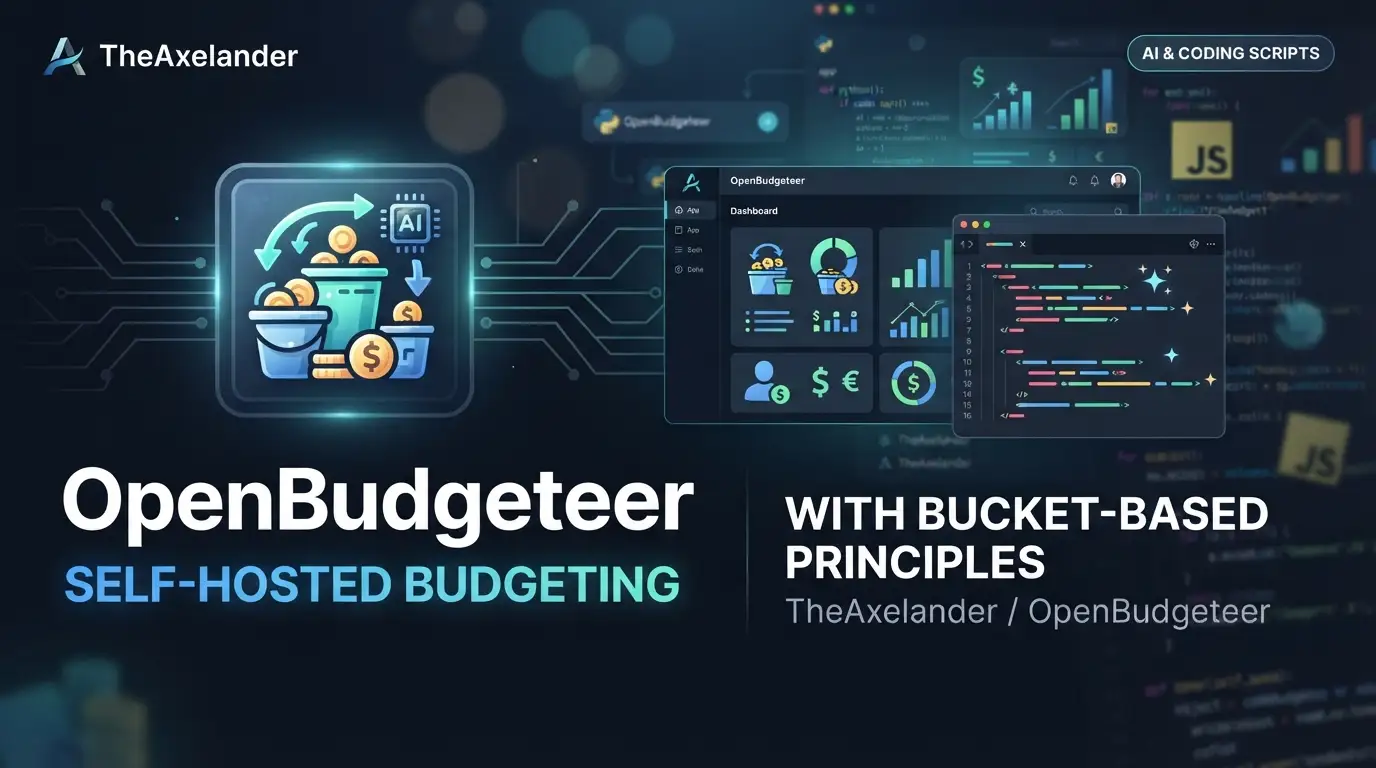
TheAxelander/OpenBudgeteer: Self-Hosted Budgeting with Bucket-Based Principles
Developers and technically-minded users often face a frustrating choice in personal finance: surrender financial data to proprietary SaaS platforms, or settle for spreadsheets that lack intentional budgeting structure. The Bucket Budgeting Principle—allocating every dollar to specific spending categories before the month begins—has proven effective, yet tools that implement it well tend to be either subscription-locked or platform-dependent. TheAxelander/OpenBudgeteer addresses this gap directly: an open-source, self-hosted budgeting application built in C# that brings bucket-based allocation to your own infrastructure, with no vendor lock-in and full data sovereignty.
This article examines TheAxelander/OpenBudgeteer as it exists today—its architecture, deployment model, and practical fit for developers who want granular control over both their code and their cash flow.
What is TheAxelander/OpenBudgeteer?
TheAxelander/OpenBudgeteer is a budgeting application explicitly based on the Bucket Budgeting Principle, drawing direct inspiration from YNAB and Buckets. It is maintained by TheAxelander as an open-source project under the GNU Affero General Public License v3.0, ensuring that all derivative works, including network-accessible deployments, remain open-source.
Technically, the application is built on .NET with the MVVM (Model-View-ViewModel) pattern at its core, while the frontend employs Blazor Server. This stack choice matters: Blazor Server enables rich interactive UI without the complexity of a separate JavaScript↗ Bright Coding Blog SPA framework, while .NET provides a mature, performant backend with strong type safety. For developers already invested in the Microsoft ecosystem, this reduces operational friction significantly.
As of January 2026, the repository shows 964 stars, 63 forks, and active maintenance with the last commit dated 2026-01-10. The project is listed in Awesome-Selfhosted, a curated directory of deploy-your-own software—a signal that the community considers it production-viable for self-hosting scenarios.
The project's relevance now stems from converging trends: growing developer skepticism of SaaS subscription creep, heightened concern for financial data privacy, and the maturation of containerized deployment patterns that make self-hosting accessible even for single-user instances.
Key Features
TheAxelander/OpenBudgeteer's feature set reflects its focused purpose: implementing bucket-based budgeting with minimal architectural overhead.
Bucket-Based Allocation System. The core abstraction is the "bucket"—a purpose-limited fund that receives allocated income and spends only for its designated category. This enforces the YNAB-inspired principle of giving every dollar a job before spending decisions arise.
Blazor Server Frontend. The UI layer uses Blazor Server rather than WASM or a JavaScript framework. This means UI logic executes server-side with SignalR managing real-time DOM updates over WebSockets. For developers, this translates to C# everywhere—no context-switching to JavaScript for frontend behavior, and reduced client-side payload.
.NET + MVVM Architecture. The backend follows MVVM strictly, separating data models from view logic through explicit ViewModel layers. This pattern, while verbose, yields testable components and clear separation of concerns—valuable for contributors or operators who may need to extend functionality.
Docker↗ Bright Coding Blog-First Deployment. The project provides maintained Docker images with automated builds for both pre-release and master branches, evidenced by GitHub Actions workflows. Docker pull metrics indicate active community adoption of this deployment path.
MariaDB Data Persistence. The quick-start documentation specifies MariaDB as the database backend, a proven choice for .NET applications via Entity Framework Core or direct MySQL↗ Bright Coding Blog-compatible connectors.
Self-Hosted Data Sovereignty. All financial data remains on infrastructure you control. No third-party analytics, no cloud dependency, no subscription pricing unpredictability.
Report Generation. The application includes reporting capabilities, with screenshot evidence of a dedicated Report Page for analyzing budget performance over time.
Use Cases
Personal Finance for Privacy-Conscious Developers. Individuals with the technical capacity to run Docker containers who refuse to route bank transactions through proprietary cloud services. The self-hosted model eliminates data residency concerns entirely.
Small Household or Family Budgeting. A single Docker instance can serve multiple user accounts within a household, with each family member's buckets isolated through application-level access controls. The bucket methodology naturally supports envelope-style household budgeting where partners allocate joint income to shared obligations.
Budgeting Education and Habit Formation. The explicit bucket allocation process—mandatory categorization of all income before spending—builds financial discipline. Developers can deploy instances for financially inexperienced family members, providing structure without ongoing subscription costs.
Integration with Existing Home Lab Infrastructure. For operators already running Docker Compose stacks for services like Plex, Home Assistant, or [INTERNAL_LINK: self-hosted monitoring tools], OpenBudgeteer slots naturally into existing reverse proxy and backup configurations.
Offline-Capable Financial Tracking. While Blazor Server requires network connectivity, the self-hosted nature means operation continues during internet outages if the server runs locally—unlike SaaS alternatives that become inaccessible.
Installation & Setup
The project emphasizes Docker-based deployment. The official documentation provides a quick-start path using Docker Compose with MariaDB.
Refer to the complete quick-start guide for current details. The general pattern follows standard Docker Compose conventions:
# docker-compose.yml structure (refer to official docs for exact current version)
# The project maintains Docker images via automated GitHub Actions:
# - axelander/openbudgeteer:latest (master branch)
# - axelander/openbudgeteer:pre-release (development builds)

services:
  openbudgeteer:
    image: axelander/openbudgeteer:latest
    # Environment variables for database connection and app configuration
    # See official documentation for complete variable reference
    ports:
      - "8080:8080"  # Default application port; adjust as needed
    depends_on:
      - mariadb
    restart: unless-stopped

  mariadb:
    image: mariadb:latest
    environment:
      MYSQL_ROOT_PASSWORD: ${DB_ROOT_PASSWORD}
      MYSQL_DATABASE: openbudgeteer
      MYSQL_USER: openbudgeteer
      MYSQL_PASSWORD: ${DB_PASSWORD}
    volumes:
      - mariadb_data:/var/lib/mysql
    restart: unless-stopped

volumes:
  mariadb_data:
Deployment steps:
-
Prerequisites: Docker and Docker Compose installed on your target host. The project does not specify minimum resources, but .NET + Blazor Server + MariaDB comfortably run on 1GB RAM for single-user workloads.
-
Pull images: The GitHub Actions workflows ensure
axelander/openbudgeteer:latestreflects the most recent stable master commit. Pre-release images are available for testing upcoming features. -
Configure environment: Database connection strings and any application-specific settings pass via environment variables or mounted configuration. The official documentation maintains the authoritative reference.
-
Initialize and migrate: On first run, the application creates required schema via Entity Framework migrations. The MariaDB container must be healthy before the application starts—
depends_onhandles ordering but not readiness; production deployments may want explicit health checks. -
Reverse proxy (recommended): For external access, place behind nginx, Traefik, or your existing reverse proxy with TLS termination. No special WebSocket configuration is typically required for Blazor Server's SignalR fallback mechanisms.
Real Code Examples
The README does not contain extensive inline code samples; the project's configuration and deployment rely on standard Docker patterns rather than custom scripting. What follows are the concrete configuration fragments directly supported by the documentation, with explanatory context.
Docker Compose service definition pattern:
# From official quick-start documentation
# Services: openbudgeteer (application) + mariadb (persistence)
# Network and volume configuration per standard Docker Compose conventions

version: "3.8"

services:
  openbudgeteer:
    image: axelander/openbudgeteer:latest
    container_name: openbudgeteer
    environment:
      # Database connection using standard .NET connection string format
      # for MySQL-compatible servers
      - ConnectionStrings__DefaultConnection=Server=mariadb;Database=openbudgeteer;Uid=openbudgeteer;Pwd=${DB_PASSWORD};
      - ASPNETCORE_URLS=http://+:8080
    ports:
      - "8080:8080"
    depends_on:
      - mariadb
    restart: unless-stopped

  mariadb:
    image: mariadb:10.11  # LTS version recommended for stability
    container_name: openbudgeteer-db
    environment:
      - MYSQL_ROOT_PASSWORD=${DB_ROOT_PASSWORD}
      - MYSQL_DATABASE=openbudgeteer
      - MYSQL_USER=openbudgeteer
      - MYSQL_PASSWORD=${DB_PASSWORD}
    volumes:
      - ./mariadb-data:/var/lib/mysql  # Bind mount for backup accessibility
    restart: unless-stopped
This configuration demonstrates the project's dependency structure: the .NET application connects to MariaDB via a standard connection string, with no exotic networking or custom protocol requirements. The ASPNETCORE_URLS environment variable controls Kestrel's binding—standard ASP.NET Core behavior.
GitHub Actions workflow badge references (verification of build health):
<!-- From README: automated build status indicators -->
[](https://github.com/TheAxelander/OpenBudgeteer/actions/workflows/docker-image-master.yml)
[](https://github.com/TheAxelander/OpenBudgeteer/actions/workflows/docker-image-pre-release.yml)
These badges confirm the project's CI/CD maturity: every master commit triggers a fresh Docker image build, and pre-release images validate changes before promotion. For operators, this means docker pull axelander/openbudgeteer:latest reliably obtains the most recent tested state.
The README's relative sparsity in code examples reflects the application's design philosophy: it is a packaged application, not a library or framework requiring integration code. Users configure, not extend, through environment variables and Docker orchestration.
Advanced Usage & Best Practices
Backup strategy. MariaDB's standard tooling (mariadb-dump or physical volume snapshots) applies directly. Schedule regular dumps from the database container, and test restoration procedures—financial data warrants verified recoverability.
Resource monitoring. Blazor Server maintains persistent SignalR connections per client. For single-user or small-household deployments, connection count remains negligible; scale CPU allocation if you observe UI latency during report generation.
Version pinning. The latest tag provides convenience but introduces update unpredictability. For production stability, pin to specific release versions (check GitHub releases) and update deliberately after reviewing changelog notes.
Security hardening. The AGPL license requires sharing source if you modify and network-deploy. If you customize, maintain a public fork. For access control, rely on your reverse proxy's authentication layer—OpenBudgeteer does not appear to implement multi-user auth natively based on current documentation.
Database maintenance. MariaDB's default configuration suffices for personal use. For larger transaction histories, monitor slow_query_log and consider periodic OPTIMIZE TABLE on high-churn tables.
Comparison with Alternatives
| Dimension | TheAxelander/OpenBudgeteer | YNAB | Buckets |
|---|---|---|---|
| Hosting | Self-hosted (your infrastructure) | Cloud SaaS only | Desktop app (local) |
| Cost model | Free (AGPL v3.0) | Subscription (~$14.99/mo) | One-time purchase |
| Data control | Complete | Vendor-managed | Complete |
| Tech stack | .NET, Blazor Server, MariaDB | Closed-source | Closed-source (Electron) |
| Bucket methodology | Native implementation | Native (originator) | Native implementation |
| Multi-user/household | Single instance, unclear native multi-user | Supported officially | Single-user desktop |
| Mobile access | Browser-based (responsive?) | Native apps | No native mobile |
| Automation/API | Undocumented; likely minimal | Bank import, extensive | Manual entry focused |
Trade-offs to consider: YNAB offers polished bank import automation and native mobile apps—conveniences that justify its subscription for users prioritizing time over data control. Buckets provides desktop-native performance without server maintenance, but lacks browser-based access and multi-user scenarios. OpenBudgeteer demands Docker operational competence and likely manual transaction entry, in exchange for zero ongoing cost and complete infrastructure ownership.
FAQ
What license governs TheAxelander/OpenBudgeteer? GNU Affero General Public License v3.0. Network use constitutes distribution; modifications must be shared.
What database is required? MariaDB, per the official quick-start documentation. MySQL compatibility is likely but not explicitly verified.
Does it support automatic bank transaction import? The README does not document this capability. Expect manual entry or custom ETL to the MariaDB schema.
Can I run this without Docker? Technically possible given the .NET runtime dependency, but Docker is the documented and maintained path.
Is there a mobile app? No native mobile application is mentioned. Browser access to your self-hosted instance is the likely mobile path.
How active is development? Last commit dated 2026-01-10 with ongoing CI/CD automation. The project shows sustained maintenance.
What happens if I modify the source code? AGPL v3.0 requires publishing your modifications if you operate the modified version over a network.
Conclusion
TheAxelander/OpenBudgeteer occupies a specific niche: developers and technical operators who value the Bucket Budgeting Principle but refuse ongoing SaaS subscriptions and external data custody. Its .NET + Blazor Server stack offers familiarity for Microsoft-ecosystem developers, while Docker-first deployment aligns with modern infrastructure practices. The 964-star community and Awesome-Selfhosted listing suggest credible viability, though prospective users should evaluate whether manual transaction entry and self-hosted operational overhead fit their patience and skill profile.
This is not a tool for users seeking frictionless automation or polished mobile experiences. It is a tool for those who treat financial infrastructure as seriously as application infrastructure—controlled, auditable, and free of recurring vendor dependency.
Ready to deploy? Clone the repository, review the official documentation, and spin up your instance: https://github.com/TheAxelander/OpenBudgeteer