
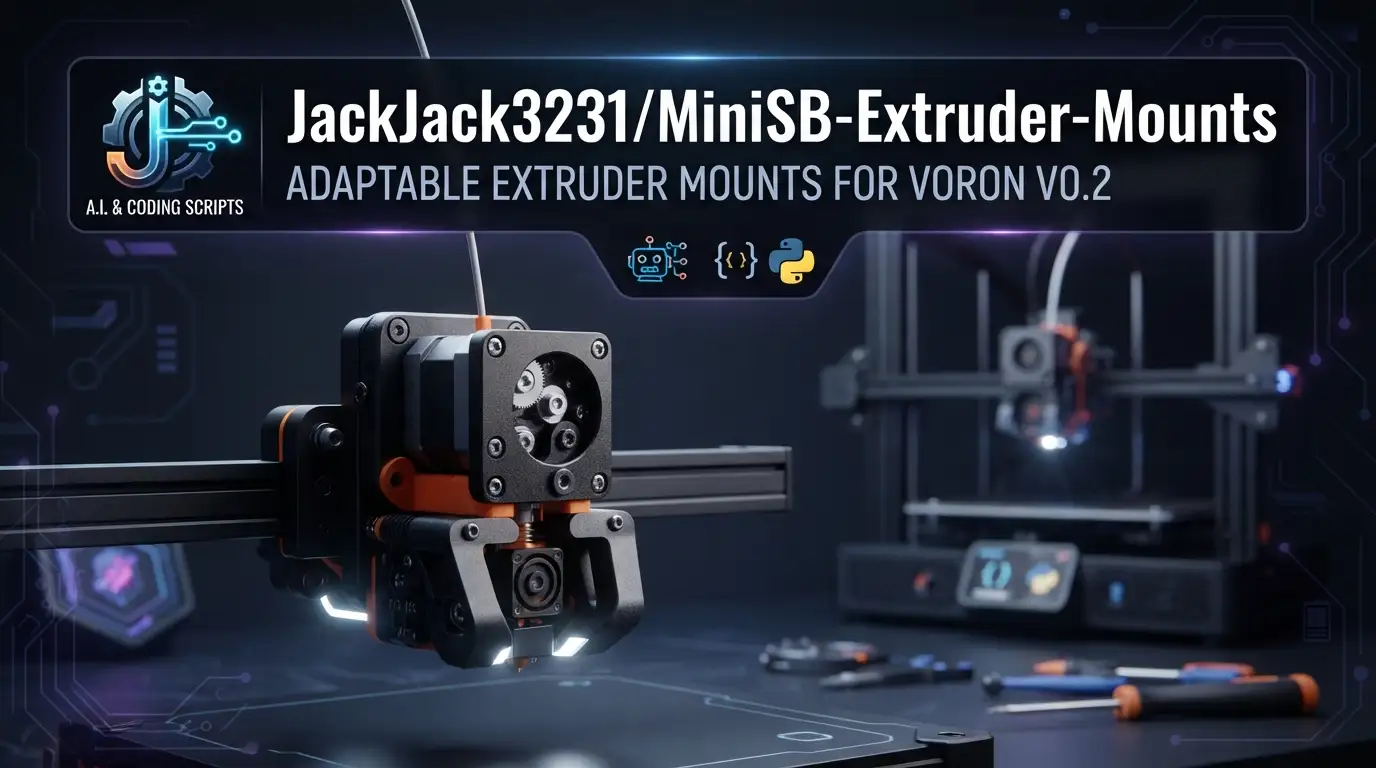
JackJack3231/MiniSB-Extruder-Mounts: Adaptable Extruder Mounts for Voron V0.2
The Voron Mini-Stealthburner is a compact, high-performance toolhead that ships with native support for a limited set of extruders. For builders running specialized direct-drive units—Bondtech LGX-Lite, Orbiter v2.0, Haldis HGX series, or Annex Sherpa variants—the stock cowling often means CAD rework or hunting through scattered mods. JackJack3231/MiniSB-Extruder-Mounts solves this by providing a unified, drop-in replacement system that retains the stock V0.2 X-carriage, hotend mount, and assembly logic while expanding extruder compatibility to over fifteen options. This article breaks down what the repository delivers, how to use it, and where it fits in the Voron hardware ecosystem.
What is JackJack3231/MiniSB-Extruder-Mounts?
JackJack3231/MiniSB-Extruder-Mounts is an open-source hardware remix project hosted on GitHub, licensed under the GNU General Public License v3.0. With 199 stars and 17 forks as of its last commit on 2024-02-17, it represents a community-driven effort to decouple the Mini-Stealthburner's extruder support from Voron Design's upstream release cycle.
The project is maintained by JackJack3231, who remixed Maverick's original LGX-Lite mod and systematically extended it across a wide extruder matrix. Rather than replacing the entire toolhead, the repository modifies only three components: the cowling, strain-relief, and spacers. Everything else—the X-carriage, hotend mount, and core duct geometry—remains stock V0.2. This design choice matters because it preserves proven thermal and kinematic behavior while eliminating the need for builders to revalidate motion systems or recalibrate probe offsets from scratch.
The repository includes two visual variants per extruder: a "Standard" version preserving the upper logo cover in front of the extruder, and a "Minified" version that strips this cover for a cleaner, Bowden-toolhead-like profile similar to the Mini-AfterSherpa. Both variants are available as ready-to-print STLs, oriented correctly with no supports required under standard Voron print settings (0.2 mm layer height, 4 perimeters, 40% infill, 5 top/bottom layers).
Key Features
Broad Extruder Coverage The repository supports fifteen distinct extruders, with verified assemblies for the majority. Verified units include Haldis HGT, HGX 2.0, Bondtech LGX-Lite, LDO Orbiter v2.0, Annex Sherpa Micro and Mini, TriangleLab TBG-Lite (left and right), TBG-S, and both Vz-Hextrudort Low CNC and Plus CNC variants. Several others—Phaetus Apus, Lerdge Aquarius, Haldis HGX-Lite, Orbiter v1.5—have confirmed mechanical assembly but await full printer integration testing. The Sherpa Heavy and Mellow Libra Mini remain unverified.
High-Flow Hotend Support Beyond standard flow configurations, dedicated "High_Flow" folders contain extended cowlings and hotend mounts for the Rapido HF and Dragon UHF. A Dragon Ace mount is also provided, usable with either standard-flow cowlings (the Ace sits 3 mm shorter) or high-flow variants with its included spacer. Builders must update firmware Z-height limits when using these taller configurations.
Probe Ecosystem Integration The project integrates four probe systems: Boop (untested, with strain-relief/PCB plate incompatibilities noted), Klicky and KlickyNG (test-fitted for collision clearance only, no dock verification), ZeroClick (with remade dock/mount and dual-Sequin LED clearance), and M8 inductive probes including SuperPINDA and PINDA variants. The ZeroClick implementation is particularly notable for preserving both Sequin LEDs where other remixes sacrifice one.
Strain-Relief and Electronics Mounting Included strain-relief plates, Umbilical-PCB mounts (Timmit's design, now with LDO Picobilical support), and CAN toolhead board mounts (remixed from KayosMaker's work) address cable management at the toolhead. Octagon spacers—printable lying down without layer-adhesion dependency—are preferred over cylindrical versions. Motor flange thickness variations (Moons at 2.5 mm vs. LDO at 2 mm) affect required spacer length, and heatset insert compression may alter alignment.
"One Fits Most" Universal Variant The Swiss Cheese cowling attempts maximum extruder compatibility with minimum part count, ideal for builders who anticipate frequent extruder swaps or want to reduce printed inventory.
Use Cases
V0.2 Builders Migrating from Bowden The Minified variant provides a direct visual and volumetric match to Bowden toolheads, making it attractive for compact builds where every millimeter of X-travel matters. The drop-in X-carriage compatibility means no rail or carriage replacement.
Multi-Extruder Fleet Operators Workshops or individuals maintaining several Voron V0.2 machines with different extruders can standardize on one cowling repository rather than tracking disparate mods. The consistent assembly manual structure and BOM organization reduce operational overhead.
High-Flow Conversion Projects Users upgrading from standard flow to Rapido HF or Dragon UHF hotends find pre-validated cowling extensions with documented Z-height tradeoffs. The Dragon Ace mount's dual-configuration flexibility (standard or high-flow with spacer) supports iterative upgrades without full reprints.
Probe-First Kinematic Setups The ZeroClick integration targets builders prioritizing nozzle-based probing accuracy. The preserved dual-Sequin LED configuration maintains chamber illumination—often sacrificed in other compact probe integrations—while the remade dock/mount reduces collision risk.
Experimental Extruder Evaluation The verified/unverified matrix and "One Fits Most" variant lower the barrier for testing new extruders. Builders can mechanically validate fitment before committing to full printer integration, with community verification tracked in the README's status table.
Installation & Setup
The repository follows standard Voron assembly conventions with extruder-specific variations documented per mount.
Print Settings Apply standard Voron parameters: 0.2 mm layer height, 4 perimeters, 40% infill, 5 top and bottom layers. No supports are required; all STLs are pre-oriented for direct import.
Assembly Sequence
-
Heatset Preparation: Install heatset inserts into spacers. For top-screw extruders, also install heatsets into the cowling body.
-
Fan Installation: Mount part-cooling and hotend fans per the V0.2 Assembly Manual pages 165-167.
-
Hex-Nut Insertion: Drop the M3 hex nut into the slot at the cowling top.
-
Extruder Attachment: Secure the extruder to cowling using hardware specified in the mount-specific BOM.
-
Hotend Integration: Install the hotend, cutting PTFE tube to extruder-specific length.
-
X-Carriage Mounting: Attach the assembly using 2× M3×35 BHCS from front, 1× M3×20 BHCS from rear.
-
Spacer and Strain-Relief: Add spacers for strain-relief or umbilical plates; verify screw thread engagement and replace with longer screws if needed.
-
Final Securing: Attach strain-relief/umbilical plate to spacers and X-carriage.
Critical Verification Step: For PCB toolhead boards, confirm mounting plate screws do not short against exposed traces or pads.
Real Code Examples
The repository's primary artifacts are CAD files and STLs rather than executable code. However, the README documents configuration-relevant parameters and file organization patterns that serve analogous purposes for hardware builders.
High-Flow Z-Height Configuration
# Firmware adjustment required for Rapido HF / Dragon UHF cowlings
# Documented in README: "Remember that this will reduce a bit of the usable z height"
# Example Klipper printer.cfg adjustment:

[stepper_z]
position_max: 120  # Reduced from standard V0.2 value; verify against your specific build
This pseudo-configuration illustrates the explicit firmware update requirement. The README does not provide exact numerical offsets because total Z-loss depends on extruder choice and spacer compression; builders must measure their assembly.
File Path Convention for Extruder Selection
# Repository structure pattern (from README description)
Extruder_Mounts/
├── [Extruder_Name]/
│   ├── Standard/
│   │   └── [Cowling, Strain_Relief, Spacers].stl
│   ├── Minified/
│   │   └── [Cowling, Strain_Relief, Spacers].stl
│   └── High_Flow/          # If applicable
│       └── [Extended_Cowling, Hotend_Mount].stl
├── _OneFitsMost/
│   └── Swiss_Cheese_Cowling.stl
└── _ZeroClick-Common/
    └── [Dock, Mount, Cowling].stl
This organizational pattern enables programmatic or scripted batch selection. A builder maintaining multiple machines could version-control their active configurations by committing symlinks or copies from these canonical paths.
Heatset Insert Depth Specification
# Spacer manufacturing note (inferred from README warnings)
# Octagon spacers: print lying down, no layer adhesion dependency
# Cylindrical spacers: standard orientation, layer adhesion critical

# Critical dimension: account for heatset insert compression
# "when installing the Heatsets into the spacers they can get squished"
# If alignment issues occur, use longer spacers from the CAD-specified size range
The README emphasizes that spacer length varies by motor manufacturer flange thickness—Moons (2.5 mm) versus LDO (2 mm)—and that post-insertion compression affects final alignment. No single numeric prescription suffices; the CAD source files provide size baselines.
Advanced Usage & Best Practices
Spacer Material and Orientation: The octagon spacers, inspired by KayosMaker's design, should be printed lying down with filament grain oriented along the load path. This eliminates the shear-plane weakness inherent in vertically-printed cylinders where layer adhesion determines structural integrity.
Motor Flange Measurement: Before printing all spacers, measure your specific extruder stepper's mounting flange. The 0.5 mm difference between Moons and LDO motors is sufficient to cause either sloppy fitment or cracked cowlings if ignored. The README notes this but does not provide exhaustive motor compatibility matrices; verify against your hardware.
Probe Dock Validation: Klicky and KlickyNG cowlings have only been collision-tested, not probing-validated. Before relying on these for automatic bed meshing, manually verify dock engagement and release across full X/Y travel. The untested Boop integration should be considered experimental; the maintainer explicitly recommends KayosMaker's CANboard mounts as an alternative path.
PTFE Tube Length Precision: The assembly instructions specify cutting PTFE to "correct length" without universal numbers because extruder filament path geometries vary. Use the CAD files—published for each extruder variant—to derive exact measurements rather than copying from a different extruder's documentation.
Version Tracking for Iterative Builds: The changelog shows active development with breaking changes (R1 duct updates, hex-nut repositioning, BOM alterations). Pin your production STLs to specific commit hashes or release tags rather than tracking main directly.
Comparison with Alternatives
| Aspect | JackJack3231/MiniSB-Extruder-Mounts | Maverick's Original LGX-Lite Mod | Mini-AfterSherpa |
|---|---|---|---|
| Extruder Coverage | 15+ extruders, unified repo | LGX-Lite only | Sherpa Mini focus |
| Visual Variant | Standard + Minified | Standard only | Minified only |
| Hotend Support | Standard, Rapido HF, Dragon UHF, Dragon Ace | Standard | Standard |
| Probe Integration | Boop, Klicky, ZeroClick, PINDA | Limited | Limited |
| X-Carriage Compatibility | Stock V0.2 drop-in | Stock V0.2 | Stock V0.2 |
| Maintenance Status | Active (last commit 2024-02-17) | Unupdated for R1 ducts per README | Community-maintained |
Maverick's mod established the foundational cowling geometry but has not incorporated V0.2r1 duct improvements or expanded beyond LGX-Lite. Mini-AfterSherpa offers a clean minified aesthetic for Sherpa Mini users but lacks the extruder breadth and probe ecosystem integration. JackJack3231's repository occupies a middle ground: broader compatibility than single-extruder mods, with more active maintenance than some legacy alternatives, at the cost of increased file complexity and verification surface area.
FAQ
Q: Does this replace my entire Mini-Stealthburner? A: No. Only the cowling, strain-relief, and spacers change; X-carriage and hotend mount remain stock V0.2.
Q: Which extruders are actually tested in printing? A: HGT, HGX 2.0, LGX-Lite, Orbiter v2.0, Sherpa Micro, Sherpa Mini, TBG-Lite variants, TBG-S, and both Vz-Hextrudort CNC versions.
Q: Can I use a Rapido HF without losing Z-height? A: No. The README explicitly states high-flow cowlings reduce usable Z-height; firmware reconfiguration is required.
Q: Is the ZeroClick probe fully working?
A: Yes, with video documentation. It requires special cowlings and remade dock/mount parts from the _ZeroClick-Common folder.
Q: What's the license? A: GNU General Public License v3.0.
Q: Why are some extruders marked with question marks? A: The maintainer lacks physical hardware for verification. CAD-accurate designs should work, but printer integration is unconfirmed.
Q: Do I need supports for any parts? A: No. All STLs are pre-oriented and support-free under standard Voron settings.
Conclusion
JackJack3231/MiniSB-Extruder-Mounts addresses a genuine friction point in the Voron V0.2 ecosystem: the gap between the Mini-Stealthburner's stock extruder support and the diversity of high-performance direct-drive options builders actually want to use. By limiting modifications to three replaceable components and maintaining stock kinematic interfaces, the project reduces upgrade risk while expanding hardware choice.
This repository best serves V0.2 owners committed to iterative toolhead evolution—whether migrating from Bowden, evaluating extruders, or integrating advanced probes like ZeroClick. The active maintenance record, explicit verification matrix, and comprehensive accessory ecosystem (strain-relief, umbilical, CAN mounts) distinguish it from narrower single-extruder mods.
The tradeoff is verification burden: with fifteen extruders and multiple hotend/probe permutations, not every combination has seen production printing. Builders should consult the README's status table, measure their specific motor hardware, and validate probe behavior before relying on automated workflows.
For the complete file set, assembly manuals, and latest updates, visit the repository directly: https://github.com/JackJack3231/MiniSB-Extruder-Mounts


