
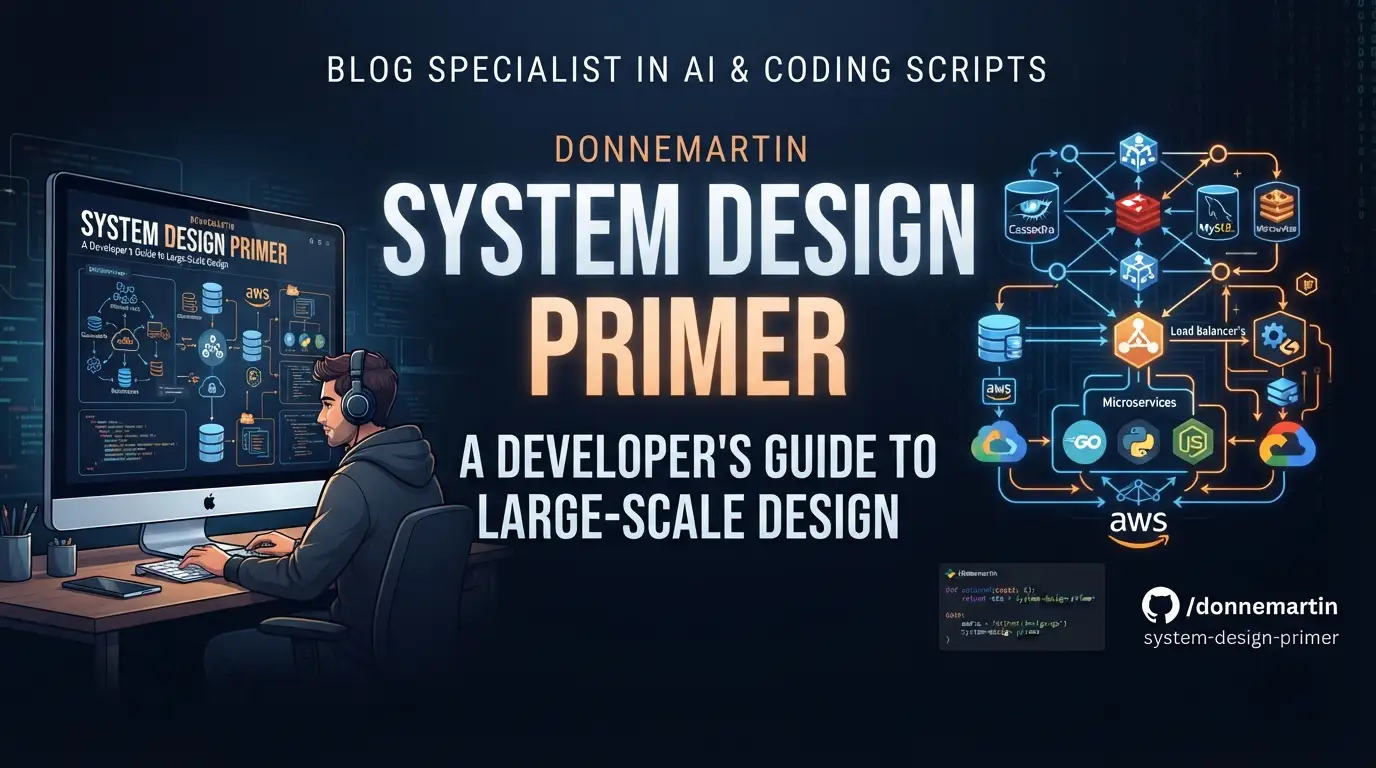
donnemartin/system-design-primer: A Developer's Guide to Large-Scale Design
Introduction
System design interviews have become a required component of technical hiring at most major technology companies. Yet the topic remains notoriously difficult to prepare for—resources are scattered across blogs, papers, and conference talks, leaving engineers to cobble together their own curriculum. The system design primer by Donne Martin addresses this gap directly. With 357,601 GitHub stars and 57,212 forks, this open-source repository has become one of the most referenced resources for developers preparing to design large-scale distributed systems. Whether you're a backend engineer targeting senior roles at top tech companies, a DevOps↗ Bright Coding Blog specialist expanding your architectural knowledge, or a frontend developer crossing into infrastructure territory, this organized collection provides structured pathways from fundamentals to interview-ready solutions. The repository includes Anki flashcards for spaced repetition learning, detailed walkthroughs of common interview questions, and comprehensive coverage of topics from load balancing to database sharding.
What is donnemartin/system-design-primer?
donnemartin/system-design-primer is an open-source educational repository maintained by Donne Martin, designed to teach engineers how to design large-scale systems and prepare for system design interviews. The project is primarily written in Python↗ Bright Coding Blog and distributed under an Other license. Its last commit was on March 20, 2026, indicating active maintenance.
The repository serves three core purposes: first, as an organized collection of system design principles that consolidates resources otherwise scattered across the web; second, as a continually updated community project that accepts contributions for fixes, improvements, new sections, and translations; third, as an interview preparation toolkit with practice questions, sample solutions, and structured study guides.
What distinguishes this resource from generic blog posts is its explicit framing of system design as a conversation about trade-offs. The repository repeatedly emphasizes that "everything is a trade-off"—a critical mindset for interviews where candidates must justify architectural decisions under constraints. The content spans foundational concepts (CAP theorem, consistency patterns, availability patterns) through infrastructure components (DNS, CDNs, load balancers, databases) to concrete design exercises for systems like Twitter, Pastebin, and web crawlers.
The repository also supports 17 language translations including Japanese, Simplified Chinese, Traditional Chinese, Arabic, Bengali, Brazilian Portuguese, German, Greek, Hebrew, Italian, Korean, Persian, Polish, Russian, Spanish, Thai, Turkish, Vietnamese, and French—with ongoing community efforts to expand coverage.
Key Features
Structured Learning Progression: The repository provides explicit study guides calibrated to interview timelines. For short timelines, it recommends breadth-focused review of system design topics with some practice questions. For medium timelines, it adds depth in select areas with more practice. For long timelines, it targets comprehensive coverage with most available exercises. This tiered approach acknowledges that candidates have varying preparation windows.
Anki Flashcard Decks: Three spaced-repetition decks are included—System Design, System Design Exercises, and Object-Oriented Design Exercises—designed for mobile review. A companion Coding deck exists in the sister repository interactive-coding-challenges.
Interview Question Solutions with Diagrams: Eight system design questions include complete solutions with discussions, code, and architecture diagrams. These cover: Pastebin/Bit.ly, Twitter timeline and search, web crawler, Mint.com, social network data structures, key-value store for search engine, Amazon sales ranking by category, and AWS↗ Bright Coding Blog scaling to millions of users.
Comprehensive Topic Index: The repository covers 30+ system design topics with summaries of pros and cons for each. Core areas include performance vs. scalability, latency vs. throughput, availability vs. consistency (with CAP theorem deep-dive), DNS, CDNs, load balancers (Layer 4 and Layer 7), reverse proxies, microservices, service discovery, database systems (RDBMS and NoSQL with replication, federation, sharding, denormalization), caching strategies (client, CDN, web server, database, application levels with cache-aside, write-through, write-behind, refresh-ahead patterns), asynchronism (message queues, task queues, back pressure), communication protocols (TCP, UDP, RPC, REST), and security.
Appendix with Reference Data: Includes powers-of-two tables and Jeff Dean's latency numbers for back-of-the-envelope calculations—essential for interview estimation exercises.
Use Cases
Technical Interview Preparation: The primary use case. The repository explicitly targets system design interview rounds at technology companies, providing structured approaches to open-ended questions. The four-step methodology—outline use cases and constraints, create high-level design, design core components, then scale—is directly applicable to interview settings.
Self-Directed Architecture Learning: Engineers transitioning into senior or staff roles use the topic index to fill knowledge gaps in distributed systems. The progression from scalability fundamentals through specific components to real-world architectures mirrors how practitioners actually build expertise.
Team Onboarding and Standards: Engineering teams adopt the repository as shared vocabulary for architectural discussions. The consistent treatment of trade-offs (CP vs. AP systems, push vs. pull CDNs, SQL vs. NoSQL) provides frameworks for evaluating technology choices.
Reference During System Design: Practicing architects consult the repository for quick refreshers on specific patterns—cache invalidation strategies, database replication topologies, or load balancing algorithms—when making implementation decisions.
Object-Oriented Design Interview Prep: The less-developed but growing section covers hash maps, LRU caches, call centers, decks of cards, parking lots, and chat servers with Jupyter notebook solutions.
Installation & Setup
The system design primer is fundamentally a documentation and resource repository rather than an installable package. Setup involves cloning and navigating the content:
# Clone the repository
git clone https://github.com/donnemartin/system-design-primer.git

# Navigate to the project directory
cd system-design-primer

# Open README.md in your preferred markdown↗ Smart Converter viewer
# Or browse directly on GitHub
For the Anki flashcards, download the .apkg files and import them into Anki:
# Flashcard decks are located in:
# resources/flash_cards/System Design.apkg
# resources/flash_cards/System Design Exercises.apkg
# resources/flash_cards/OO Design.apkg

# Download and open in Anki desktop or AnkiMobile
The solutions are organized in the solutions/ directory with subdirectories for system_design/ and object_oriented_design/. Each contains README files with discussions and, where applicable, executable code:
# Example: Navigate to Pastebin solution
cd solutions/system_design/pastebin
# Open README.md for the complete walkthrough
For Jupyter notebook solutions in object-oriented design:
# Install Jupyter if not already available
pip install jupyter

# Launch notebook server in the relevant directory
cd solutions/object_oriented_design/lru_cache
jupyter notebook lru_cache.ipynb
No additional dependencies are required for the core documentation. The repository is designed for immediate consumption after cloning.
Real Code Examples
The repository's value lies primarily in architectural explanations and diagrams rather than extensive code samples. The following examples reflect the actual documentation structure:
Example 1: Back-of-the-Envelope Availability Calculation
The repository provides formulas for calculating system availability, critical for interview estimation questions:
# Components in sequence (availability decreases)
Availability (Total) = Availability (Foo) * Availability (Bar)
# If Foo and Bar each have 99.9% availability:
# Total: 99.9% * 99.9% = 99.8%

# Components in parallel (availability increases)
Availability (Total) = 1 - (1 - Availability (Foo)) * (1 - Availability (Bar))
# If Foo and Bar each have 99.9% availability:
# Total: 1 - (0.001 * 0.001) = 99.9999%
This demonstrates the repository's emphasis on quantitative reasoning—interviewers expect candidates to compute availability for multi-component systems quickly.
Example 2: Cache Invalidation Strategy Comparison
The documentation outlines four caching patterns with trade-offs:
# Cache-aside: Application manages cache
# - Read: Check cache, on miss read from DB and populate cache
# - Write: Update DB, invalidate cache
# - Pros: Cache failures don't block application
# - Cons: Potential stale data between DB write and cache invalidation

# Write-through: Synchronous cache and DB update
# - Write: Update cache, cache synchronously updates DB
# - Pros: Strong consistency
# - Cons: Higher write latency

# Write-behind (write-back): Asynchronous DB update
# - Write: Update cache, cache asynchronously batches DB writes
# - Pros: Low write latency, high write throughput
# - Cons: Risk of data loss if cache fails before DB write

# Refresh-ahead: Proactive cache refresh
# - Cache predicts and refreshes hot data before expiration
# - Pros: Reduced latency for predicted access patterns
# - Cons: Complex prediction logic, potential wasted resources
These patterns appear in solutions for high-traffic systems like Twitter timeline design.
Example 3: System Design Interview Approach Structure
The repository provides a methodology rather than code, but structures it with explicit steps:
Step 1: Outline use cases, constraints, and assumptions
- Who is going to use it?
- How many users are there?
- What are the inputs and outputs?
- How many requests per second?
- What is the expected read to write ratio?

Step 2: Create a high level design
- Sketch main components and connections
- Justify your ideas

Step 3: Design core components
- Dive into details for each component
- Discuss API and object-oriented design

Step 4: Scale the design
- Identify bottlenecks
- Apply load balancer, horizontal scaling, caching, sharding as needed
This framework is consistently applied across all eight solved interview questions.
The README explicitly notes that object-oriented design solutions use Jupyter notebooks (.ipynb files) rather than raw code blocks, with examples like solutions/object_oriented_design/hash_table/hash_map.ipynb containing executable Python implementations.
Advanced Usage & Best Practices
Calibrate Depth to Your Timeline: The repository's study guide is its most underutilized feature. Engineers with two weeks should prioritize the "System design topics: start here" section and 2-3 solved questions; those with two months can work through most exercises and add depth in specific domains relevant to target companies.
Use Anki for Distributed Practice: The flashcards are specifically designed for mobile review during commutes or breaks. Spaced repetition is empirically effective for retaining terminology-heavy material like consistency models and availability calculations.
Practice Verbal Explanation: The repository emphasizes that system design interviews are "open-ended conversations" where candidates lead. Reading solutions silently is insufficient—record yourself explaining architectures, or practice with peers, to develop fluency in trade-off justification.
Study Company Engineering Blogs in Parallel: The repository includes a section linking to company engineering blogs. Cross-referencing solved questions with published architectures from target employers (e.g., Twitter's timeline, Netflix's CDN strategy) strengthens answers with real-world validation.
Contribute to Fill Gaps: The "Under development" section marks content needing polish. Contributing fixes or translations builds deeper understanding while improving the resource for others—consistent with the repository's open-source, community-learning model.
Comparison with Alternatives
| Feature | donnemartin/system-design-primer | Designing Data-Intensive Applications (book) | System Design Interview (YouTube/online courses) |
|---|---|---|---|
| Cost | Free (open source) | ~$50-60 USD | Often $100-500+ |
| Format | Markdown docs, diagrams, Anki decks | Comprehensive print/digital book | Video lectures, sometimes with community access |
| Interactivity | Self-paced, community contributions | Static text | Varies; some include mock interviews |
| Code Examples | Limited; architecture-focused | Extensive theoretical depth | Varies by creator |
| Interview Specificity | Explicit interview prep with solved questions | Broader systems education | Often interview-focused |
| Update Frequency | Active (last commit March 2026) | Periodic editions | Varies |
| Depth vs. Breadth | Broad coverage, interview-appropriate depth | Exceptional depth, academic rigor | Varies widely |
Trade-offs: The primer excels at structured interview preparation and quick reference but lacks the theoretical depth of Martin Kleppmann's Designing Data-Intensive Applications for engineers building production systems. Paid courses may offer mock interview practice and feedback that self-study cannot replicate. The primer's strength is its zero-cost accessibility and community-maintained currency.
FAQ
Q: Do I need to know everything in the repository for interviews? A: No. The README explicitly states that interview questions depend on experience level, role, and company. Start broad, then deepen in relevant areas.
Q: What license covers the content? A: The repository lists "Other" as its license. Review the LICENSE file directly for specific terms.
Q: Are the Anki decks compatible with AnkiMobile?
A: Yes. The .apkg format works across Anki desktop, AnkiWeb, and AnkiMobile.
Q: How current is the AWS scaling solution? A: Last repository commit was March 20, 2026, but verify specific AWS service references against current documentation as cloud platforms evolve rapidly.
Q: Can I use this for non-interview learning? A: Yes. The "Learn how to design large-scale systems" motivation explicitly targets general engineering improvement, not just interview prep.
Q: How do I contribute translations? A: Open an issue referencing #28 or follow the Contributing Guidelines in CONTRIBUTING.md.
Q: Is there video content? A: The repository links to external video lectures (e.g., Harvard scalability lecture) but contains no native video.
Conclusion
donnemartin/system-design-primer delivers exactly what it promises: an organized, community-maintained path from scattered system design knowledge to interview-ready competence. Its 357,601 stars reflect genuine utility rather than hype—the repository solves a concrete problem for engineers facing high-stakes technical interviews without structured preparation materials.
The resource is best suited for: software engineers preparing for senior+ interviews, self-directed learners seeking breadth in distributed systems, and teams establishing shared architectural vocabulary. It is less suited for those seeking deep theoretical foundations (consider Kleppmann's book) or hands-on mock interview practice (consider paid courses or peer groups).
The combination of topic breadth, solved questions with diagrams, spaced-repetition flashcards, and explicit study guides creates a complete preparation system at zero cost. For engineers serious about system design interviews, this repository belongs in your preparation stack.
Start with the System design topics: start here section, add Anki reviews to your daily routine, and work through solved questions using the four-step methodology. The repository awaits at https://github.com/donnemartin/system-design-primer.


